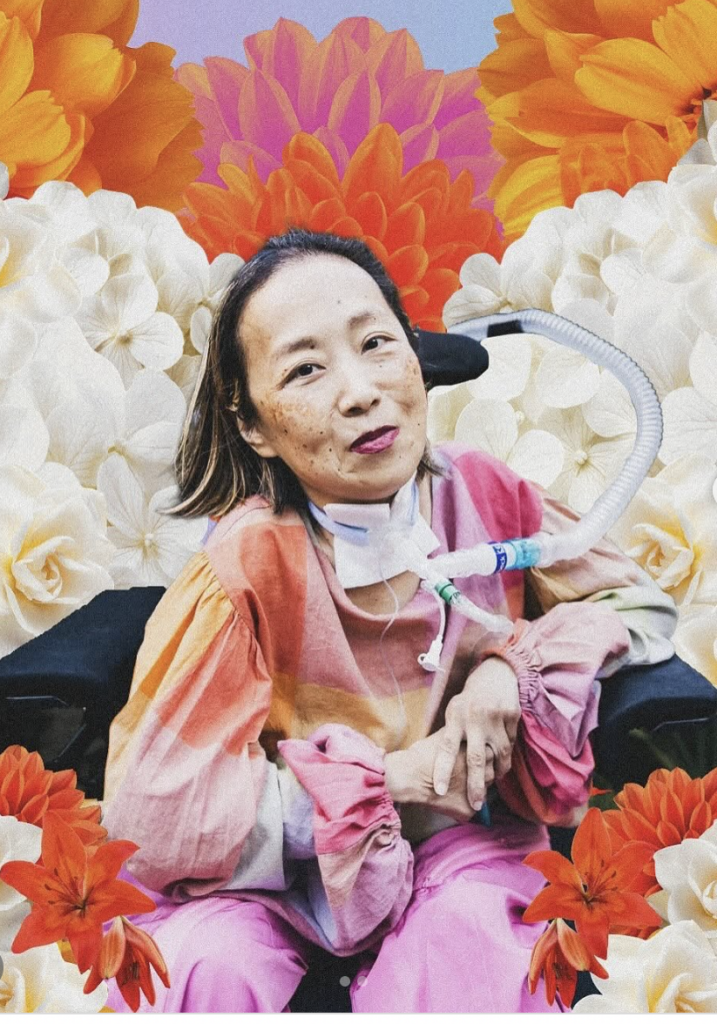
I met Alice five years ago, at the start of the hardest point in my life. My brother was sick and passed away months later. My parents became ill, and I was under the weight of that, as well as starting a new career in disability journalism advocacy. Alice reached out and welcomed me to the disability community. She supported me through my brother’s death and the chaos of grief afterward. She also taught me how to be in community.
Alice is quintessential Generation X. Let me explain: Gen X often gets painted as a generation of loners. This is a fundamental misunderstanding of our true nature. We are actually interdependent. We weren’t coddled and were told to figure it out on our own. We didn’t figure it out on our own; we did it in community. Our childhoods were full of adventures, figuring out how the world worked by trial and error. We were feral, but we looked out for each other and figured out how to get out of danger together. We became excellent problem solvers without the supervision of adults.
As Disabled adults, we fundamentally understand that the system is not built for us, so all we have is each other. Alice was the leader of our feral pack. I have been Disabled my whole life but didn’t live in community for most of my life. She taught me about interdependence and refusing to take the shit the system served.
One time, Alice and I were teaching proper disability coverage to a group of editors and reporters from the largest legacy media outlets in the country. Alice had some examples of bad coverage and was in the middle of explaining how to fix it. The Zoom chat blew up. These editors and reporters were indignant that Alice would dare to critique the work of journalists. The implication was we had no right to critique them, even though we were both journalists. When I took over speaking, Alice got right into that chat and clapped back at all of them. My favorite was something to the effect of, “I wasn’t specifically speaking of your work, but now maybe I am.” They quieted down after that, and I was in awe of her. I learned that day not to defer. To go ahead and clap back when I needed to.
It was also the moment when the essence of the Disabled Journalists Association was born. Alice can be seen and felt in everything we do. Alice left us with a lot of infrastructure, and people for years to come will feel the power of her hard work. I was lucky enough to be able to work alongside her.
After we received the news of Alice’s transition, we invited people who loved, knew or worked with her to offer memories in the format that worked best for them. Some were interviews with DJA staffers. Others were written responses to questions. Some were sent as voice notes. The remembrances, which are published in three parts, were curated by contributing editor Sonali Gupta. Jennifer White-Johnson provided illustrations.
A virtual celebration of life for the Disability Visibility Project founder is scheduled for March 25, from 11 a.m. to 1 p.m. Pacific Time. Watch the livestream at the San Francisco Disability Cultural Center’s YouTube channel.
— Cara Reedy
Steven Thrasher
I first connected to Alice through Twitter, in what I think was the golden age of Twitter, when you could really meet communities there. Sometimes they were your own community. Sometimes they weren’t. Sometimes you could just eavesdrop in other people’s communities.
I’m pretty sure we connected shortly before or after the second wave of the Black Lives Matter movement when Michael Brown was shot. I had worked for StoryCorps and knew about the origins of Disability Visibility. I think I knew who Alice was, but the first conversation I remember having with her was when I was posting about the intersection of disability and police shootings.
I was reporting a lot for The Guardian on Black Lives Matter and how people who have deafness or are on the autism spectrum, often Black disabled people, were among those most killed by police. That was our first real conversation.
At some point Star Trek came up. I was doing my PhD and rewatching The Next Generation while writing my dissertation, and she was very interested in it. We talked about my book The Viral Underclass and the interview she gave for it.
Our books came out around the same time, even though I interviewed her for my book first. We became friends who talked about the process of publishing books, the racism in publishing, and the racism in dealing with editors.
When she passed, I felt a little imposter syndrome, as I often do. When I saw what people were saying about her, I thought she must have had much closer friends than me.
Since she passed, it’s been amazing to see how many people had some connection with her. Dozens or hundreds of organizations memorialized her, not in a superficial way but because they had real relationships with her.
She served me food even though she couldn’t eat. That moved me deeply. You didn’t have to feel bad walking around her or eating in front of her. She had also sent me care packages when I was suspended from teaching. One came after she could no longer eat. There were three kinds of cookies she and her sister made.
She had an extraordinary capacity not to be jealous, which is something that consumes many people.She wanted to hear about your problems and support you.
She made people less self-conscious about disability. If people were walking on eggshells, she would talk openly about bodies—farting, fucking, burping. Humor cut through that discomfort.
She did not suffer bullshit.
In the last year of her life she hosted dinner parties even though she couldn’t eat. Someone described her as piss-your-pants funny, which was true.
Her humor helped people relax but also warned people not to mess with her.
She expanded the idea of what a journalist could be.
She was fearless and tireless, but also very tired. She was in pain. She could be angry.
She believed in being fully human—angry, joyful, funny, complicated.
Sometimes we would talk about who might be a good editor for a piece. We also asked each other to share our work.
Twitter was a completely different world then. It created a really nice environment and community for discovering each other.
When Disability Visibility came out, I invited her to give a talk at Northwestern University. She understandably said she couldn’t do an hour and might be able to do twenty minutes if we were okay with her potentially canceling. Of course we were.
We were also in contact a lot about Gaza, signal boosting each other’s campaigns. We ended up writing a piece together when six journalists had an extra-large target placed on them by Israel. Two of those journalists have since been killed.I asked her if she wanted to work on the piece with me. I’m proud that I got to share a byline with Alice. We got about 400 other people to sign on to the piece.
Even the first time I talked to her she supported the Black Lives Matter movement.
She was also great at making connections between Black disability justice and Palestinian liberation, and understanding it through the concept of debility and the purposeful debilitating of people.
She understood that what was happening in Gaza was a crisis for everyone, but particularly frightening for disabled people who were losing access to medication and care.
She also collaborated behind the scenes without telling me. When I was first suspended from teaching at Northwestern because of pro-Palestinian efforts, a letter signed by 2,800 people circulated around the world. She helped organize it. When I was later denied tenure, she helped with another letter and circulated it among disability activists.
Of course she had people she knew in San Francisco. Because of her disability, because of Covid, and because of this era of internet relationships, she was well positioned to build deep intimacy with people she met online.
During Covid, when people felt isolated, she had experience with isolation and knew how to build community online in meaningful ways.
She had an extraordinary ability to bridge movements. She supported causes in their own right while also showing their connections.
Someone like her could have had an extraordinary career without engaging Palestinian politics. Instead she expanded her moral imagination.
People wrote to her out of the blue and she responded with respect.
If people want to honor her, they should hire journalists like her.
She left guides for how journalism can be more inclusive, including welcoming voices that speak with lisps or use assistive technology.
Journalists have a responsibility to continue that work.
She was part of a movement. Her death doesn’t end the work.
People often assume disabled people must feel like they are missing out on life. Alice acknowledged the complexity of those feelings but also took joy in celebrating what other people could do.
It was a meaningful friendship to me, even though I only got to spend time with her in person once.
One of my favorite exercises was having students watch my interview with Alice and write about it without reading what I wrote. Then we would compare everyone’s work and talk about editorial choices. She became instrumental to my teaching practice.
She showed what becomes possible when disabled people receive the support and care they need.
She did an extraordinary amount in 51 years.
Her work will reverberate for a long time.
Jennifer White-Johnson
Alice’s passing is still very raw and present for me. Many of us are actively mourning the loss of our friend and frequent creative collaborator. This article is a beautiful reflection of our relationship.
She would ask me to create collages to celebrate her birthday, or I would make them as reminders of our friendship.
She was a strong, often harsh critic of policies and systems, but kind to individual people.
Celebrating her while she was with us was always paramount for me. It’s important to celebrate your people while you still have them close.
As difficult as it is not to have her here, her spirit continues to guide me—to question the unjust, uplift the forgotten, and ensure our stories are never erased.
Jane Shi
I met Alice in 2021. It feels like she had been in my life much longer. It’s hard to describe what Alice has meant to me in what has been a uniquely isolating time, a time of disabled resistance, solidarity, joy, rage, and grief, without talking about the conditions that led our paths to cross.
She loved her cats, Star Trek, beautiful things, delicious food, shutting down nonsense, and sending people mail. Alice was #fashun, hilarious, and open to growing and learning with everyone else.
The past few years of the pandemic have taken many disabled lives cruelly and unnecessarily and created new waves of debility through genocide, fascism, climate catastrophe, and organized abandonment.
Alice was a disabled oracle. She knew what was ahead of us, what was at stake, and what kind of care and community-building would be required to withstand it. She also knew we were going to laugh our butts off while doing it.
Alice believed in me. She connected me to beautiful souls around the world, from disabled writers through the Disability Visibility Project to people surviving genocide in Palestine through our project Crips for eSims for Gaza.
She knew those connections were essential to our collective survival and possibility-making. The solidarity work we participated in renewed disability justice commitments to Palestine and created space for persistent solidarity that refused the disposability of organizer bodyminds.
Alice fought for those connections. She fought for us. She modeled firm boundaries. That is an Alice lesson I return to again and again.
Grieving her reminds me how much I grew through her care, friendship, and mentorship.
I will be grateful to Alice for the rest of my life.
We are an interdependent web of connective tissue. I think Alice would want us to continue changing the world together and replicating the care webs she built. Maybe that means she lives on through us.
More DJA Coverage
After we received the news of Alice's transition, we invited people who loved, knew or worked with her to...
By
March 25, 2026
After we received the news of Alice's transition, we invited people who loved, knew or worked with her to...
By
March 25, 2026

We’ve been asked repeatedly at DJA why we capitalize the word Disabled in our reporting. So, for this piece,...
By
March 23, 2026