Photo Credit: Shaylin Sluzalis
This reporting was supported by a grant from the nonprofit media organization Grist. You can see more of our climate package here.
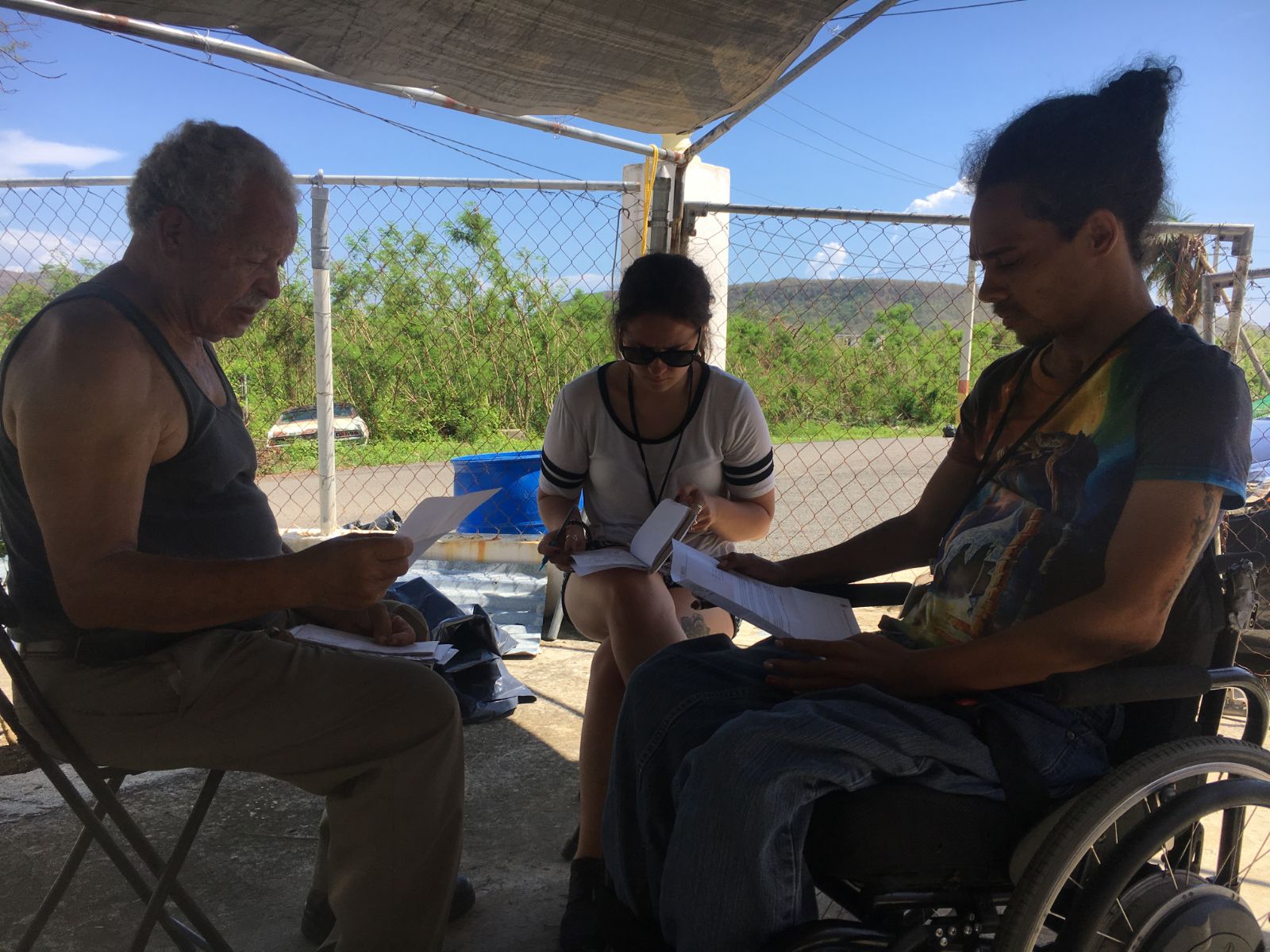
In 2017, after Hurricane Maria tore through Puerto Rico, Germán Parodi received a call. The Partnership for Inclusive Disaster Strategies, a U.S. disability-led organization focused on the needs of Disabled people before, during and after disasters, was doing recovery work on the ground. However, they had no knowledge about the condition of Disabled people who were affected. Parodi had left Puerto Rico several years prior knowing that, as a quadriplegic, if catastrophe was to strike, he might not survive.
“The likelihood of hurricanes [in Puerto Rico] along with the already ableist infrastructure, made me decide to move to the United States,” he said. “It was not built for me and the propensity of hurricanes would exacerbate that experience,” Parodi told DJA. The call came as he was in Philadelphia at a protest for ADAPT, a grassroots disability-rights activism network.
Parodi, now co-executive director of Partnerships, along with his partner Shaylin Sluzalis decided to return to Puerto Rico. They were deployed as first responders where they discovered how little planning and communication was being made to ensure the safety and recovery of Disabled residents. The magnitude of destruction was astounding; there were never-before-seen landslides across the island, thousands of homes destroyed with thousands more people displaced. Communication and engagement between The Center for Independent Living (CIL) and Puerto Rican Emergency Management Agency was nonexistent. Much of their time was spent in rural regions of the territory, the inner parts of the island and mountainous areas, where care services weren’t as available.
“We saw many people with disabilities who, even two weeks in, went without any support from the local government. The planning to support people with access and functional needs was zero. No Red Cross, no FEMA. The power had been out. There was no water system running,” Parodi told DJA.
Parodi, who was on the ground for three weeks. It was clear that unless concrete disaster strategies were in place, Disabled residents in rural areas would be living under constant threat. To this day, tens of thousands of people throughout the island experience a power outage every week without notice after the power grid was destroyed during Maria.
Hurricane Maria along with many other climate-change related calamities have changed the landscape of what disaster planning strategies for Disabled people look like and calls into question what safeguards are in place to ensure Disabled people are not abandoned once again.
Zooming Out, Rural Communities
There have been no shortage of climate related disasters in the last two decades of US history: Hurricane Katrina, prolonged droughts in the Southwest, Hurricane Helene, houses in the Carolina’s falling into the ocean due to sea erosion, wildfires running throughout California, Oregon and New Mexico, energy and heat crises in the West. United Nations data shows that Disabled people die or are injured two to four times more often than the general population in disasters. As climate disasters grow more intense, safety and evacuation planning becomes the deciding factor in determining who gets to live.
The effects of climate-related disasters afterwards still linger today. Take Superstorm Sandy, for instance, a disaster where the homes of thousands of Disabled residents in the Atlantic were wiped away overnight in 2012. Jeff Peters, Director of Communications at the Center for Independence of the Disabled, New York was on the ground during Superstorm Sandy and saw the carnage firsthand.
“The aftermath of Superstorm Sandy was devastating for many New Yorkers and those in the surrounding areas,” he said. “People who relied on home-assistance devices or accommodations like chair lifts were stuck on the first level of their homes, cutting them off from areas of their own home. Lack of power also limited the use of refrigerators, which some people may use for medication, as well as electronic medical devices such as oxygen machines, nebulizers, CPAP machines, and more,” he continued.
Part of the issue was that recovery efforts did not meet the needs of the community. Disabled communities fought back and, in 2013, a federal court in New York ruled in favor of Disabled residents affected by the superstorm, finding the city’s disaster planning strategies “inadequate and discriminatory”. It was a first of its kind ruling and a major win for the community.
Agencies like FEMA are transparent about their shortcomings, outlining 14 Points of Inequity that names how the organization failed to meet the needs of the disability community. Some of those areas include the need for ASL interpreters, screen readers, accommodating special dietary needs like liquid food, power dependency for medical equipment and more. Even still, years later affected residents are still struggling to recover as erosion becomes a bigger issue. “Rebuilding,” Peters said, “was a community effort, at least in the locations I was directly involved with. Some residents face or faced expensive home repairs and modifications that they were not prepared for, on top of the damage initially caused by Sandy years earlier” he said.
Advocates tell DJA that if Disabled people in major cities are struggling to evacuate, access shelters, or receive care during climate disasters, the challenges can be even more severe in rural communities. For people who rely on wheelchairs, ventilators, caregivers, or regular medical treatment, simply leaving home during an emergency may be impossible without coordinated support. Instead of finding accessible shelters, many Disabled rural residents often choose to shelter in place. Dr. Sherman Gillums, Jr. FEMA’s Former Director of Disability Integration and Coordination at FEMA recounted a field call during Hurricane Katrina.
“There was a mom with two adult sons with autism who had decided they were better off sheltering in place in her car, not because it was safer, not because of anything that had to do with the disaster, she feared that the people in the shelter would misunderstand her two grown boys and didn’t want to have to explain their behavior during a disaster,” Gillums said at a roundtable earlier this year. “We have to get people to be thinking about preparation as a first response.”
That’s when organizations like Upstream Access come in. Erin Taylor, executive director of the cross-disability community supporting Oregon and Southwest Washington, explains how Upstream Access got started.
“I always say first responders can only be the first in one place, “ she told DJA,“We had hosted several listening sessions for cross disability and emergency preparedness to find where the gaps were. There weren’t gaps, there were crevasses,” she said.
The organization works on independent center-person first planning, shifting some of the ownership to individuals, their families and communities. They also created a resilience kit stocked with comfort items like journals, fidgets, sensory stickers, and noise machines to give people a sense of control and support.
“We found three main messages that we kept hearing over and over again: they were training, resources and social connection. That social connection piece was so huge, and shows how fear-based emergency preparedness really has become and has traditionally been,” Taylor continued, “I think that’s so empowering for a person to have a real choice.”
People Are Stepping Up and In
Those who spoke to DJA for this story see a lack of emergency preparedness in the Disabled community as a deeply rooted and systemic issue. Parodi described issues he still deals with in the aftermath of disasters, such as oxygen-tank users being turned away at shelters and told to go to “special needs shelters” to plug in their tanks.
“We are against segregated shelters. Everybody should be welcomed into every shelter, and every service should be provided there,” he said. Not to mention service animals and wheelchair users being turned away. In one case, his organization supported an evacuee who had been forced to sleep in their wheelchair for ten days after Hurricane Ian hit Florida in 2022 because a supposedly accessible shelter couldn’t provide a bed.
However, emergency management coordinators do some strong work to fill in the gap. States like California, Nevada, Colorado have employed chief resilience officers, a relatively new role where someone is responsible for creating plans that help an organization prepare for, respond to, and recover from challenges like climate disasters, financial problems, or cyberattacks.
Taylor works one-on-one with Natasha Fox, Chief Resilience Officer at the Oregon Department of Emergency Management. “I meet monthly with Natasha [Fox] so we can keep a temperature gauge on what the community needs. They hold a monthly equity call for anyone who wants to come,” Taylor explains. “A couple of months ago, we had a big conversation on how Public Alerts are not accessible for multiple reasons,” she shared.
Most community members in the area are not signed up for Public Alerts and yet, when Taylor tries to assist someone to sign up, there are many steps and a lot of barriers for people. especially if English is not their primary language. The Department plans to hold multi-day exercises deemed ‘hard times’, a type of mock drill, to help Disabled people prepare ahead of time.
Everything (Including Storms) is Bigger in Texas
Another area where Disabled people are at particular risk is Texas.
In 2021, during Winter Storm Uri, Texas residents experienced a new type of climate change-related disaster. Author of “Disabled Power: A Storm, A Grid, and Embodied Harm in the Age of Disaster,” Dr. Angela Fredericks outlines the effects of the slow rise and sudden impact of climate change related disasters. “When we think about climate change, we immediately think about rising temperatures, and that is true,” Fredericks told DJA.
Some scientists argue that Winter Storm Uri was linked to rising Arctic temperatures, which may have disrupted the jet streamAccording to this theory, warming in the Arctic caused the jet stream to become unstable, allowing extreme cold to reach regions like Texas that are not equipped for that kind of weather.Scientists and researchers also point to “weather whiplash” events tied to the intensifying climate crisis: long stretches of drought interrupted by sudden, severe flash flooding like disasters in the Southwest, where prolonged heat and drought dry out and harden the soil, making it difficult for the ground to absorb water when heavy rain finally arrives.
Whatever the cause, energy and power outages are the number one common denominator throughout disasters like these. Many Disabled residents are power dependent for vital medical equipment like oxygen and CPAP machines as well as powered mobility aids, where someone’s independence and health would deteriorate without them. Refrigeration of medication is also a concern, for everyday supplies like insulin. According to Fredericks part of the challenge is that a lack of support has left energy costs as a significant sore spot.
In the case of Texas, the state deregulated much of its electricity market in the early 2000s, moving from a system that paid companies to maintain backup power to what Fredericks describes as a “scarcity market.” Critics say this left the grid vulnerable when millions lost power and heat during the storm. The disaster also drew scrutiny aimed at GovernorGreg Abbott, a wheelchair user, as Disabled Texans were disproportionately affected by the outages.
“The state stopped paying systems to have extra electricity on standby,” Fredericks explained to DJA. “And the reason for this is that if we’re always teetering on the edge of collapse, it drives up energy prices,” Fredericks explained.
Accessibility Barriers Also Front of Mind in the Pacific Northwest
When disaster strikes, rural areas of the Pacific Northwest are in a uniquely tough position when it comes to accessing services. Taylor said that a lack of digital accessibility, alongside lower adoption rates of air conditioning have dire impacts for rural Disabled people in the region. “Evacuation varies so much depending on Wi-Fi, because there’s parts of Oregon where there is no Wi-Fi. So cell towers are not a thing. It looks totally different from urban versus rural here in the Northwest, …In Oregon, so many homes don’t have air conditioning because, growing up, that was never something we needed. The seasons have shifted by entire months,” she said.
The Pacific Northwest exists in a state of tumultuous danger when it comes to the effects of climate change. In April of this year, there were more than a dozen smaller offshore earthquakes off the coast of Washington. Structures like the Oregon State’s Gladys Valley Marine Studies Building are being built to serve as a means of shelter and help with evacuation. The 47-foot high roof is meant to protect people from the impact of a potential tsunami. The Marine Studies Building also doubles as a learning center.
But vertical structures, while important, don’t account for the needs of the Disabled community.
In Tokeland, Washington, a first of its kind vertical evacuation tower was built by the Shoalwater Bay Indian Tribe to protect residents from potential major earthquakes and tsunamis. The tower is capable of holding 400 people, about the population of the entire town. However, the lines of stairs leading up to the top makes it inaccessible for people with mobility disabilities and elderly individuals. Emergency management is aware but has not developed real alternatives. In a Facebook post, Washington Emergency Management Division responded to requests for information about how Disabled residents would access the structure during a disaster by saying, “Neighbors are being trained to help each other up the tower. After a big quake, a power source needed to operate lifts is unlikely to work. It’s a concern. But in this location a tsunami would arrive in 35 minutes and everyone would head here.”
While that suggestion rings hollow for many, Parodi said that community is a strength in rural areas during trying times that others don’t have access to, even as concerns like a lack of usable water or available emergency beds pile up.
“There are barriers in urban [cities] too where you often don’t know your neighbors in the same way that rural people do,” he told DJA.
Paths Forward
So, where do we go from here?
There are still significant gaps in the system. In Puerto Rico, $1 billion was allocated in the 2023 government funding omnibus bill established by the The Department of Energy’s (DOE) Puerto Rico Energy Resilience Fund (PR-ERF) benefiting disabled and low-income communities in Puerto Rico was later rescinded. Parodi said advocates had pushed hard for the initiative, which committed to installing 30,000 units in low-income homes. According to Parodi, 18,000 units were approved but only 6,000 were installed before the program was abruptly shut down in January of this year.
That’s not to say there haven’t also been meaningful, moderate improvements – The 2010s saw some of the most structural changes with the incorporation of Regional Disability Integration Specialists in 10 FEMA regions covering all 50 states. The specialists, who include qualified sign language and certified Deaf interpreters, provide guidance to people living in disaster areas. Peters shares, “We have seen an expansion of the flood zone maps and evacuation communications. We have seen the development of an NYC climate dashboard,”
For Taylor, it’s about Disabled people having agency in their decisions when disaster looks like it’s about to strike. “If you have to decide, do I turn on my air conditioner, or do I have food or take my medication, that’s not okay,” she said.
Parodi says we can also take lessons from the pandemic. “When planning doesn’t include everyone, planners are purposely deciding some people are expendable. Planning for the person with the most needs makes it easier to provide services to everyone else. The pandemic demonstrated that failing to plan for everyone means planning for some people to die.”
More DJA Coverage
The Minnesota Department of Human Services is planning to replace Housing Stabilization Services, a Medicaid program that was so...
By
October 12, 2026
A bipartisan committee in the U.S. House of Representatives is affirming the rights of Disabled people to live in...
By
September 30, 2026
Fear not — Section 504 is still the law. That's the message disability rights attorneys and advocates are stressing...
By
September 25, 2026