This reporting was supported by a grant from the nonprofit media organization Grist. You can see more of our climate package here.
How CorpsTHAT Brings The Deaf Community Into Outdoor Stewardship
By: Ari Saperstein
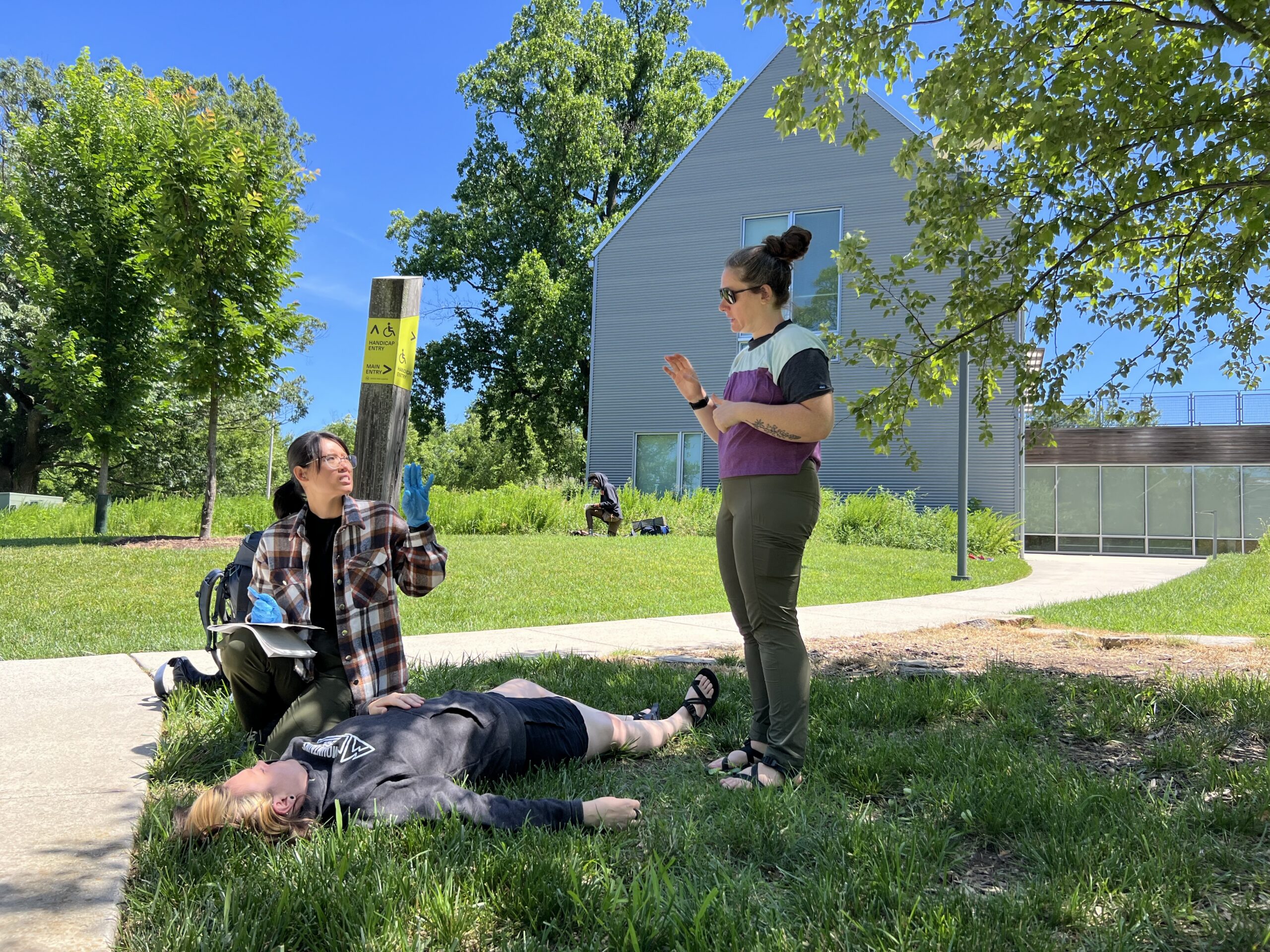
Being in a trail maintenance crew means using tools you might not find in your average garden shed: you’ll switch between loppers to clear brush, an excavating tool to break up the path, and a rake hoe to tamp it back down — sometimes all in a few minutes. Learning to use them properly requires training.
For Marlo Bragg, training left her with more questions than answers: “A Deaf person is not gonna be looking at the hearing person, they’re gonna be looking at the interpreter. So I’m completely missing what is being shown in the demonstration.” Two competing visuals — an ASL interpreter on one side, the tool demo instructor on the other — meant it was almost impossible to follow. “You have to show something and then explain, or vice versa. There’s no overlap there. It doesn’t work for us.”
Bragg is one of the co-directors of CorpsTHAT, a nonprofit that supports the inclusion of Deaf and hard-of-hearing people in conservation corps and outdoor programs. Their work includes running ASL crews, staffed entirely by Deaf leaders who provide the kind of inclusive training that wasn’t available to Bragg. Some of their crews focus on increasing accessibility outdoors, like widening trails so that adaptive mountain bikes can run through more smoothly.
CorpsTHAT offers inclusive training and ASL classes to partners at national park and forest service offices. Bragg says the goal isn’t just greater communication, but helping ASL crews feel seen by hearing partners. “ They join our program, and they realize, ‘Wow, our partners know how to sign? They understand Deaf culture?’ They look at me in the eyes and not look at the interpreter. They see me as a person.’”
Among the 55 crew members CorpsTHAT has supported since 2021, 50% have returned as participants in their programs. Co-founder Emma Bixler says their mission is best reflected in the organization’s name: “We came up with CorpsTHAT because ‘THAT’ in the ASL community is like an idiom – it’s ‘hitting the nail on the head’, you know, something that’s clearly understood.”

Photo Credit: Edwin Verin
How Disability Support Organizations Are Helping Disabled People Prepare in RuralMichigan
By: Kelli Finger
Severe weather and prolonged outages do more than knock down trees and cut the power. For older adults and Disabled residents in rural northern Michigan, they disrupt vital services.
In response, the North East Michigan Community Service Agency, (NEMCSA) takes a person-led approach, according to the organization’s Community Resource and BOSS Program Manager, Amanda Bergeron.
“…We offer a live chat feature on our website staffed by NEMCSA team members, providing real-time support when it matters most. Our Community Resource Team plays a vital role in helping individuals navigate available services and resources during emergencies, ensuring no one is left without guidance or support,” she said.
That kind of person-led support places emergency preparedness within a broader climate and disability justice framework. As severe weather becomes more disruptive, preparedness is not simply a checklist of batteries, bottled water, and flashlights. It is access to communication, , medical continuity, and trusted local guidance. Tools like NEMCSA provide allow for Disabled people to have agency in these situations.
Elsewhere in the region, the Disability Network Northern Michigan says Disabled people are often overlooked in government emergency preparation plans. The organization promotes Smart911, a service that allows residents to create a profile with medical and household information that can appear during an emergency call for dispatchers and EMS.
The organization assists community members with disabilities in creating profiles with Smart-911. It does not run the service but ensures that those in their massive service area can be connected to help if they have an emergency.

Photo Credit: Alexander Mirt
How One Indigenous Leader is Restoring Sovereignty Beyond Borders
By: Caroline Keane
“When you walk on that landscape, that land will know your footsteps, because it’s the footsteps of you and your ancestors that are not foreign to that land.”
Those words from his aunt stay with Rodney Cawston as he strives to restore his people’s sovereignty and natural abundance beyond a border, between Washington State and British Columbia, that was imposed on them. He has spent much of his life working to restore the salmon population to their former abundance from his home on tribal land in Eastern Washington.
Cawston, who is partially deaf, descends from Walwáma Nimiipuu aka Nez Perce, Arrow Lakes Sinixt and Okanagan peoples and is a member of the Confederated Tribes of the Colville Reservation. When the US and Canadian governments created their respective reservations and reserves and violently dispossessed Indigenous peoples of their land and forcibly relocated them, Cawston’s grandmother whose traditional Sinixt territory spanned both sides of the border, had to choose where she would be forced to live. She went to the Confederated Tribes of the Colville Reservation, her access to her family members, resources, and land north of the border was severely restricted.
In 2021, the Sinixt people, formerly declared extinct by Canada, had their hunting rights affirmed for tribal members living on the U.S. side of their traditional territory after years of legal battles led by the Confederated Tribes of the Colville Reservation. Cawston was Tribal Chair at that time and has continued striving to restore his people’s natural resources, including salmon. Salmon is an important resource to many Indigenous peoples, especially those in the Pacific Northwest, and are not only an important source of sustenance, but vital to their culture and way of life. The salmon were once highly abundant in the area and some species are now at risk of extinction according to researchers.
Restoration of salmon was a critical part of Cawston’s work as Tribal Chair, his doctoral thesis and through various organizations such as Salmon Orca Project and Upper Columbia United Tribes. He has been a part of ongoing years-long efforts to restore the salmon to their former abundance via yearly releases that bolster the population.
“One day I feel that my future generations will question, what did our ancestors do to protect our resources? When all of these discussions were taking place to use up all of our natural resources for profit, how did our ancestors feel about this? I hope that some record will exist that will exemplify to them that we did want for their future and some of us fought hard for the sustainable use of our resources,” he told DJA.
More DJA Coverage

On August 20, Arizona State University hockey player and St. Louis Blues draftee Matthew Mayich collapsed due to a...
By
September 9, 2026
Ed Markey has been fighting for disability rights for decades At a very brief first glance, the...
By
September 4, 2026
Although achievements in music, film and theater are dominating public remembrances of Dolly Parton, who died this week at...
By
August 26, 2026