
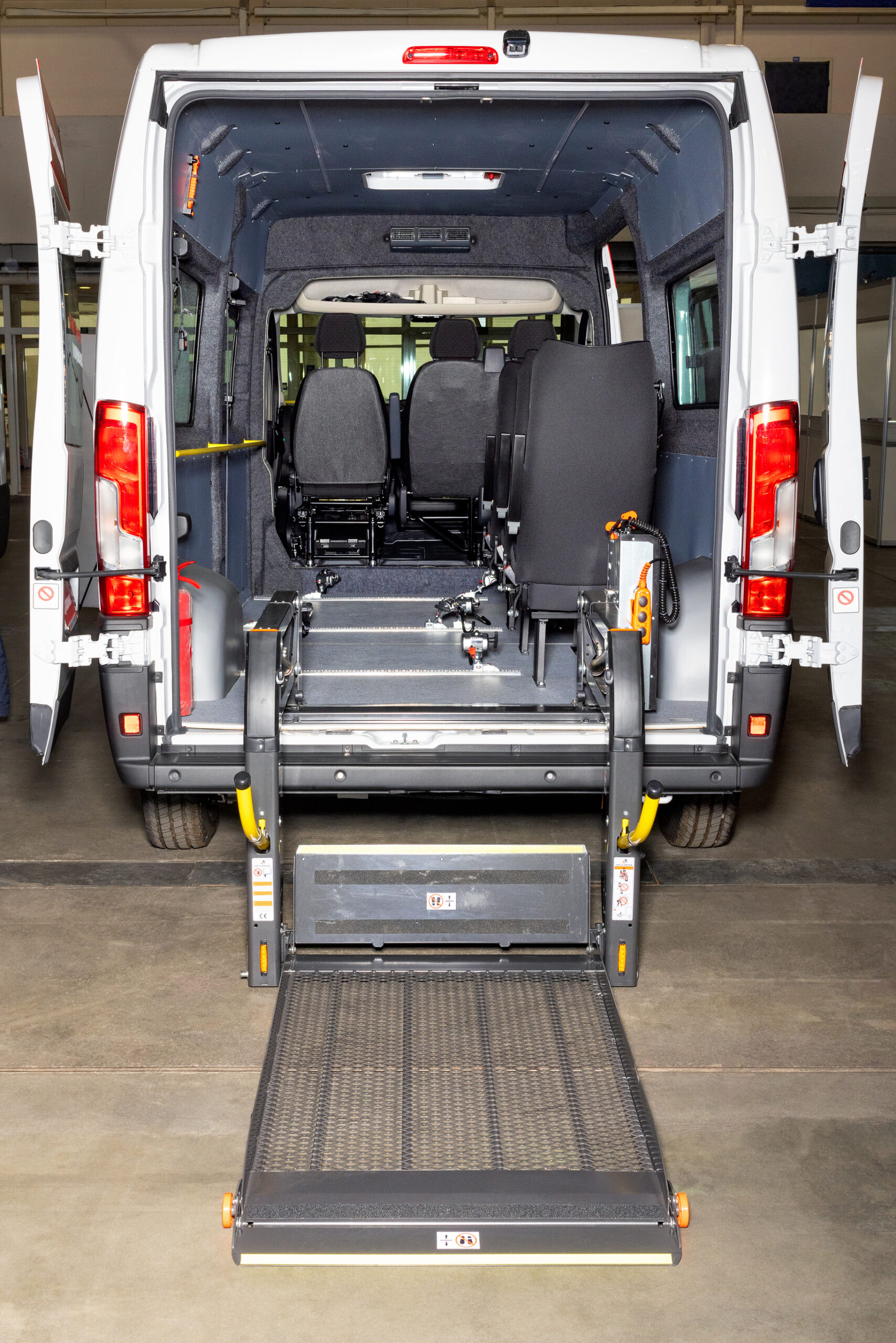
Photo Credit: Sergii Petruk
This reporting was supported by a grant from the nonprofit media organization Grist. You can see more of our climate package here.
In April, Quinn Meehan was trying to get back home to Bethany, Connecticut after taking a late Sunday evening trip to New York City. Meehan, who is an ambulatory wheelchair user, lives in a rural town of approximately 5,200 residents with no paratransit and relies on a local subsidized taxi program in the state that is often booked up a week in advance.
On that trip, a representative for the service told them they could only get home if someone else canceled their ride. Each time Meehan called to check, staff made them go through the full scheduling process—pickup time, drop-off, among other details—before saying there were no cancellations, leaving them in a precarious situation.
“If I was not ambulatory at all and didn’t have a friend with an accessible apartment in New Haven… the second closest town that has any sort of public transit, then I don’t know what I would do, frankly. I wouldn’t have been able to get home until Friday, and I wouldn’t have anywhere to go, which is obviously scary,” they explained.
Paratransit has become a vital form of accessible transportation for Disabled and elderly Americans across the country. Yet, rural and remote parts of the country are frequently forgotten because of issues with available paratransit, including the complete lack of services in some areas. Beyond that, those in places that do have paratransit services are grappling with a broader conversation around how transit and climate justice are inherently intertwined.
“Paratransit is, like most public transportation in rural and remote areas, either woefully under-resourced and not nearly adequate, and in many places, it’s non-existent,” said Nebraska-based disability advocate Stacy Cervenka.
Paratransit in the U.S.
In 1990, the passage of the Americans With Disabilities Act (ADA) required certain public transit operators to provide paratransit service within three quarters of a mile of existing fixed-route bus or rail lines. This origin-to-destination accessible transportation service method came as a response to traditional, fixed-route public transit that were and still are often inaccessible to Disabled people.
Cervenka explained that paratransit was designed mostly for occasional trips like doctor’s appointments or errands, rather than for Disabled people to live full lives.
“The challenge with paratransit is [that] it was really conceived in a time and thought of in a way like this will help so-and-so get to the doctor or their once a week trip to the grocery store,” she said. “It wasn’t really conceived to help people live active lives, to be employed, to go to school.”
According to the U.S. Government Accountability Office, riders can schedule a paratransit ride by calling the transit agency’s reservation center at least a day in advance. The transit dispatch center then creates a schedule for the partransit vehicles on the day of, which then pick up riders and might make stops to pick up other riders before dropping off at the predetermined destination. However, in rural areas, the system’s execution has been lackluster.
Sydney Steuernagel, who lives in a Long Island town that is more rural than suburban, explained that Suffolk County has county-wide paratransit, not just the minimum quarter-mile around fixed bus routes like in Nassau County. Because of this, she doesn’t have to plan trips around bus stops or worry whether destinations are close enough to fixed-route transit to qualify, providing more flexibility and access.
But Steuernagel takes issue with several aspects of paratransit in her area, including the limited number of buses and drivers in the county.
“There’s more clients and more people to use it than availability for bus and rides and things like that. So getting [a] time for trips that I’m taking can be difficult to do,” she explained.
Paratransit in Suffolk County also requires a 90 minute minimum between drop-off and pick-up, making quick trips or multiple stops impossible.
“I think that can be a negative because sometimes I have to do something, and it’s only a quick trip, and I know that when I book it, I’m going to have to make the trip an hour and a half long, even though I wouldn’t naturally stay there that long,” she said.
The 90-minute minimum is common in the Midwest as well, Cervenka said, noting that this can also create a barrier for people who need to make stops along the way to their destination.
“Many paratransit systems do not allow you to make stops. So a parent who is on their way to work can’t drop a kid off at childcare and then continue on to work. Often they require 90 minutes between trips. So what that would look like is a parent drops their kid off at preschool and now is there for 90 minutes doing what? Hanging out in the parking lot?” she said.
According to research from the American Foundation for the Blind, a lack of transit options creates a cycle where disabled people can’t access transit services, they can’t get to their jobs, they lose access to the workforce and they stay in poverty. At the same time, experts have shown that poverty and climate change are deeply connected.
Those who spoke to DJA point out that paratransit systems as they are currently constructed in rural areas are only adding to the problem.
Environmental Concerns of Paratransit
The way the paratransit system is currently scheduled causes unnecessary fuel use and environmental harm, Steuernagel pointed out. For a night out with friends, paratransit systems often send out multiple buses, despite riders going in the same direction, rather than grouping them together. Drivers also must wait in the vehicles for long periods with the engine running because the next rider’s pickup window hasn’t started yet.
“If they pick me up and then they go to the next person, if the next person’s window doesn’t start until, say, 1 o’clock, but they get there [at] 12:30, they tell [the driver] to wait that half an hour. So they’re sitting there waiting half an hour, wasting my time, the driver’s time, and also the gas of the bus,” she said. “That’s not good for the environment.”
Researcher and Ohio resident Fletcher Grey shared concerns when it comes to paratransit in rural Ohio, where transit systems only recently expanded, they said.
The Stark Area Regional Transit Authority (SARTA) provides a paratransit service known as ProLine to disabled and elderly residents in Massillon and the rest of Stark County, Ohio. According to the Canton Repository, in February 2025, SARTA began providing only federally mandated guaranteed paratransit service to and from locations within three quarters of a mile of fixed bus routes, which excluded communities such as Minerva Canal Fulton, and more sparsely populated towns.
“[Paratransit is] largely inaccessible when it comes to places like Canal Fulton…It’s where my family lives, and though there are paratransit services like Koala drivers or personal cars that you can get with SARTA, they’re often at the bare minimum of what people need at times,” Grey said, “There is a definitive need for more stops and for things to actually be put in place because the rural communities are often the ones, percentage wise, that have those higher disabled populations.”
According to the Census Reporter, 21% of the population in Canal Fulton are 65 and older, about 20% higher than the rate in Ohio. Meanwhile, in North Lawrence, the median age is 55.3 with people ages 60 to 69 making up 12% of the population,
Grey added that the buses used for paratransit are often outdated and rely on older equipment to operate, which directly affect emissions.
“I believe there might be an increase in emissions because we are focusing on more individual engines instead of just one full stop thing,” they said. “It becomes more of a socioeconomic problem as well because when you have so many people with disabilities investing in a type of business model that allows for them to go from one place to another, it impacts gas prices.”
One thing is clear: paratransit advocates see transit justice and climate justice as deeply intertwined and they want change.
More DJA Coverage

Editor's note: This article is republished, with permission, from Rewire News Group. This story contains sensitive content, including depictions of...
By
July 28, 2026

It is an odd state of affairs when you’re not sure if one of the most prominent Republicans of...
By
July 9, 2026
Despite a wave of media coverage suggesting that action from the Trump administration means the loss of a...
By
June 30, 2026