
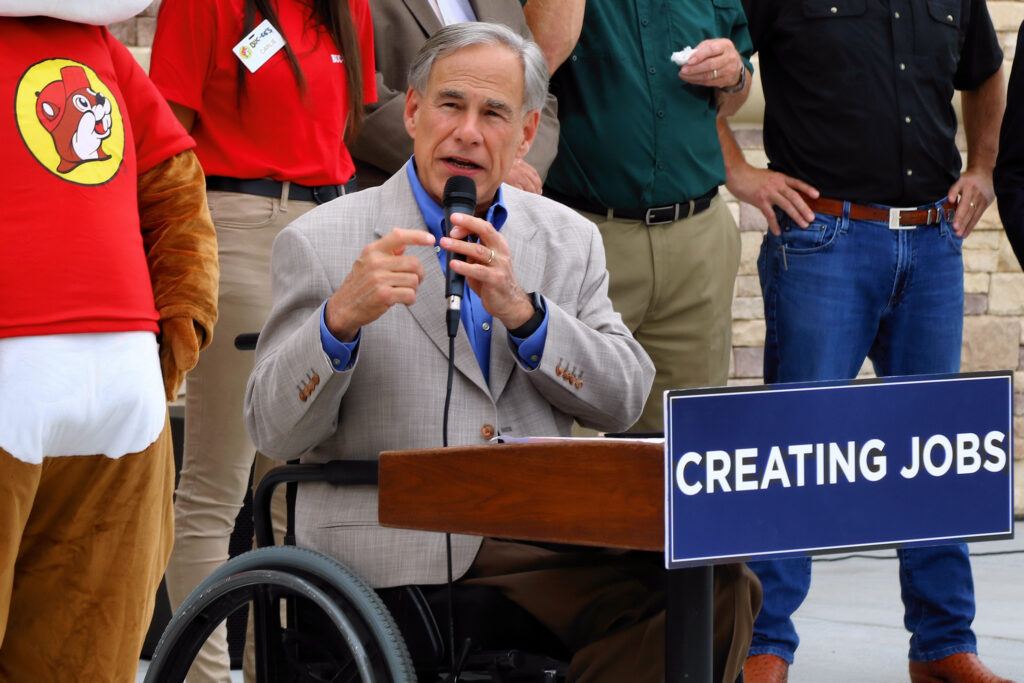
Put simply, last Tuesday’s midterm elections mean that two of the biggest thorns in the side of the disability rights movement no longer hold the reins of power in Texas. Gov. Greg Abbott, a wheelchair user, lost to Democratic state Rep. Gina Hinojosa of Austin in the governor’s race, while Attorney General Ken Paxton — architect of some of the most repressive disability-related lawsuits this century — lost his U.S. Senate bid to Democrat James Talarico.
Abbott has drawn the ire of disability rights activists across the nation in many ways, and many of his actions reek of hypocrisy. He has made public life harder for transgender children, presided over a particularly punitive abortion ban and championed deeply unpopular AI data center projects. Perhaps most maddening for some in disability communities, he made it possible for social workers to turn away Disabled clients, and as attorney general, he worked to block enforcement of the Americans with Disabilities Act.
At the same time, Abbott himself has been the target of ableism. Some commentators frustrated with his policies dubbed him “Governor Hot Wheels,” and his disability has increasingly become part of the conversation about his fitness for office. Still, it’s hard to see Abbott’s exit as anything other than a win for disability rights in the state. In 2023, for example, he vetoed a bill that would have made mail-in voting easier for Disabled people, and at the height of the COVID-19 pandemic, he barred cities from imposing mask mandates.
In academic circles, this is known as lateral ableism — when a Disabled person directs ableist policies, attitudes and practices at other Disabled people. In politics, it may look like a familiar move — pulling the ladder up behind you — but it can feel especially egregious to Disabled Texans, who number nearly 3 million, according to recent data.
Texas is also a hotbed of disability culture, including a decades-long commitment to parasports programs in places like Arlington, and the state has thrown its weight around on disability issues on both sides of the aisle. George H.W. Bush, who signed the ADA into law in 1990 after relentless pressure from advocates, started his political career in a Texas congressional district.
Which brings us to Ken Paxton.
Paxton, the state’s outgoing attorney general, succeeded Abbott in that office and lost to Talarico in Tuesday’s Senate race. His problems were legion — including his 2023 impeachment by the Republican-led Texas House and suspension from office, though the state Senate later acquitted him — and there was a growing sense that his nomination gave Democrats their easiest path to flipping a Senate seat in Texas. And fall he did, losing to Talarico by just over 12 percentage points and handing Democrats a win considered unfathomable only months ago.
Paxton’s record on disability rights is as dire as his electoral prospects turned out to be. He led the effort to reduce enforcement of Section 504 of the Rehabilitation Act of 1973, a key pillar of disability rights in the U.S., initially under the pretext of removing protections for people with gender dysphoria. The statute stands, but the current administration is not enforcing it.
But Paxton’s disregard for disability rights did not begin with that case. Years earlier, he fought unsuccessfully to execute Bobby Moore, a man with an intellectual disability on Texas’ death row. Moore was paroled in 2020 after 40 years behind bars.
Taken together, Paxton’s and Abbott’s losses point to an electorate fed up with a cruel status quo. Beyond the economy and foreign wars, Texas voters — particularly in Latino communities — were clearly motivated to hold the government accountable for supporting Immigration and Customs Enforcement raids and related deaths. As DJA has previously reported, President Donald Trump’s approach to immigration enforcement, buoyed by Republican-led states like Texas, is itself a disability issue.
What remains to be seen is whether disability rights will recover in the state now that both men are leaving office. What is clear is that the issues facing Disabled people and members of other marginalized groups resonated with voters enough to kick both to the curb.
More DJA Coverage

We’ve written extensively at DJA about how responses to disasters like tsunamis and earthquakes tend to be inaccessible. That...
By
November 5, 2026

Laura White, 40, of Michigan, paid the same fee as everyone else when she applied for her professional license...
By
November 2, 2026

Tiana, 33, of Windsor, Colorado, who asked that her last name not be published, expected her ride home from...
By
October 30, 2026
