
Tiana, 33, of Windsor, Colorado, who asked that her last name not be published, expected her ride home from a medical appointment to be covered by her health insurance. Instead, the ride never showed, and she was stranded.
“Because I use a heavy power wheelchair, I am unable to use ride share services because they can’t accommodate me. I had to call in a favor from a friend who had a trailer to take me and my chair home. The cost of the ride was $80. Being stranded meant I had to have food and a drink. This was another unexpected expense of $15. A regular Uber would’ve been able to get me sooner so I wouldn’t have needed extra food and drink, and would’ve been a quarter of the price. Being disabled is expensive.”
Affordability has remained a major national concern through the past two election cycles. Americans continue to wrestle with the cost of housing, food, health care and other necessities. Those worries are carrying into the 2026 midterms. About 84% of registered voters surveyed by the Pew Research Center this fall said the economy was very important to their vote, making it the top issue among both Republican- and Democratic-leaning voters. Earlier polling also singled out the cost of living and affordability as especially prominent concerns, suggesting that household expenses will be an important consideration for voters this election.
For some in the Disabled community, affordability isn’t only about choosing the lowest price. A less expensive ride, home, technology, hotel or service may exist without being accessible, workable or available when it’s needed.
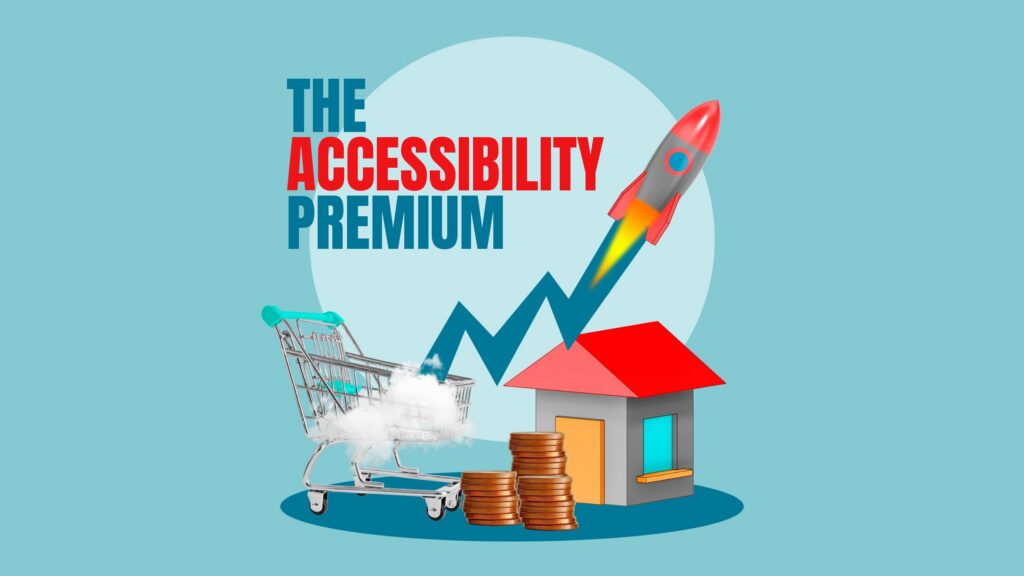
The difference between the least expensive option and the one a person can actually use can become an accessibility premium. For the people in this story, paying that premium is what allows them to keep their independence.
The Everyday Accessibility Premiums
Transportation is one place where that difference becomes visible. The Bureau of Transportation Statistics reported that in 2022, 14.3% of people ages 18 to 64 with travel-limiting disabilities lived in households without a vehicle. The agency also found that people with travel-limiting disabilities were more likely to reduce travel, ask others for rides or rely on specialized transportation arrangements.
Kyle Schaefer, 41, an IT programmer analyst in Dearborn, Michigan, is legally blind. His housing choices have been shaped partly by the availability of transportation.
“To live closer to where there are services that I need, like a bus line, it tends to be in a more densely populated and higher demand area and then, therefore, more expensive. This was true when I bought a house. This was true when I was renting an apartment,” he said.
Cheaper housing farther away could also mean losing proximity to the transportation and services that make the location workable for him. Schaefer said, half-jokingly, that gaining 20/20 vision and getting behind the wheel would solve most of his problems. That’s how essential a vehicle is.
Laura White, 40, a licensed mental health therapist in Michigan who has been blind since birth, faces a similar calculation when buying groceries. Services such as Instacart or Shipt may look like conveniences to most folks. She uses them because she can’t shop in a store without assistance. “I can’t always rely on family. They’re wonderful, but they have their own lives. So now I’m going to pay a little bit more for every single thing that goes in that cart. I’m going to pay someone to shop for me. I’m happy to do that, but I’m going to pay for them to deliver it and I need to tip them if they do a good job. And so now I’m using something that is a lifesaver for me because it means, oh, hey, I can get groceries whenever I need them. But I also have to take into account that it costs me more.”
Technology presents another choice where the least expensive option doesn’t necessarily make the most sense. White deliberately buys Apple Mac computers. She pays more upfront for the computer because VoiceOver, the screen reader she uses, is built into the operating system. For her, that is preferable to buying a less expensive Windows-based computer and potentially paying separately for the screen-reader software she prefers.
Lawrence Seiler, 53, a New York City photojournalist and podcaster who has cerebral palsy, visual impairment and hearing loss, also described technology as something he can’t eliminate from his budget. He uses accessibility tools and software, including ZoomText and Dragon, in his professional and personal life.
“It’s very hard to cut back on expenses when you kind of have to spend,” he said.
Travel Premiums
Before her disability diagnosis, Laura Calascione-Nguyen, 46, used to fly from New Jersey to Canada and back again for work in a single day. Now that she lives with Ehlers-Danlos syndrome, a connective-tissue disorder, and mast-cell-related conditions that can trigger allergic-type reactions, ordinary travel choices can require additional planning and expense.
“I travel with an air filter,” she said. “I can’t really eat cheap food on the road either.”
Calascione-Wynn pointed to a trip to Boston as one example of how her disability has changed the time and expense required for a trip. A trip that might otherwise involve a quicker turnaround now requires at least two hotel nights. “I can’t make that trip without a minimum of two nights stay.”
She searches for newer hotels and, when possible, tries to find accommodations without carpeting because of her environmental health needs. The added expense doesn’t always come from paying extra for something explicitly labeled accessible. It also comes from ruling out lower-priced arrangements that don’t work for her.
Accessibility premiums can be attached to where someone lives, how they travel, what they buy or which services they can use. And because disability needs vary so widely, some people encounter these added costs constantly while others rarely do.
Lia, 26, a nonprofit administrator in Milwaukee, and her two roommates can generally use less expensive alternatives in their daily lives. “I’m able to do the generic with my medications. I don’t need the brand name. I am usually able to go with the least expensive possible option. We buy mostly store brand groceries and 90% of the time it’s fine.”
Her experience underscores how individualized these costs can be. The accessibility premium isn’t a fixed surcharge attached to disability. It appears when a person’s specific needs narrow the choices that are actually usable.
That difference can be easy to miss from the outside. The cheaper option may still exist on paper. It simply may not be an option for the person expected to use it.
When that happens, affordability starts at a higher price.
More DJA Coverage
For Ricole Wicks, 38, an entrepreneur from Greensboro, North Carolina, independence means preserving enough energy to get through the...
By
October 29, 2026

When a gunman walked into a school in Bend, Oregon, last month, he didn’t shoot at just any classroom....
By
October 29, 2026
Affordability has remained a major national concern through the past two election cycles. Americans continue to wrestle with the...
By
October 28, 2026
