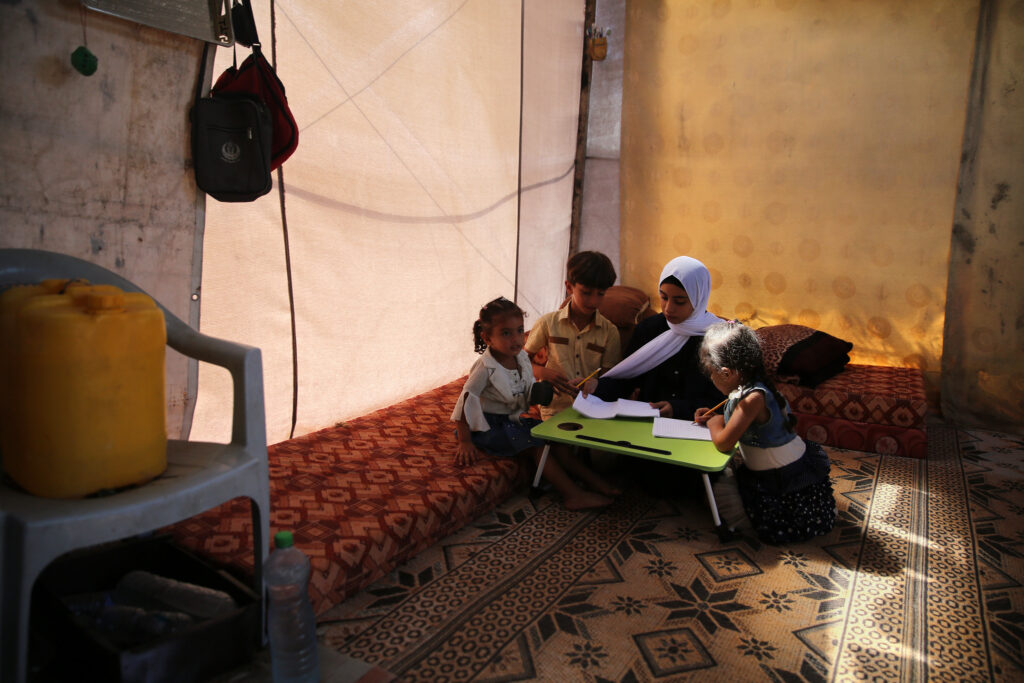
There is a dearth of coverage about the hundreds of thousands of people, including 21,000 children, who have become disabled as a result of the war in Gaza. Photo: UN Women/Suleiman Hajji
For more than 40 years, an organization called Project Censored has collated what it calls “the most important stories of each year on the basis of the exposure that was denied to them by forces beyond the First Amendment.”
If there’s anywhere that needs more reporting, it’s Disability. In DJA’s rendition, the most common reason for this lack of viewership is good old fashioned ableism. Before we dive in, please note that when we call these underreported, that doesn’t mean they haven’t been reported on at all.
There are good people doing good work on these stories. To this end, we’ve included a link to some further reading that can help with that lack of coverage.
Israel’s Bombardment of Palestine as a Disability Rights Issue
War, no matter the perpetrator, is inherently a mass disabling event. However, as headlines have proliferated, there is a distinct lack of coverage about how disability is being exacerbated in the region. Not just through the ongoing war amidst a shaky ceasefire that Israel routinely violates but also via methods such as the continual starvation of Palestinians because of aid blockaids. TruthOut has a good analysis about chronic illness in Gaza. And even though there is a fair amount of coverage about the most final of disabilities, death, there is a dearth of coverage about the hundreds of thousands of people, including 21,000 children, who have become disabled as a result of the war in Gaza. An August 2025 report from the United Nations’ Office of the High Commissioner also found that some 83% of people with disabilities in Gaza lost their assistive devices, such as wheelchairs and hearing aids. This, in addition to the ongoing PTSD, childhood disability, and the long lasting effects of war on the body and the psyche demands more attention from the Western news media.
The horrifying impacts of Russia’s Invasion of Ukraine on Disabled People
Russian soldiers’ use of intellectually disabled people as human shields sounds like the plot of a dystopian novel. However, the UK’s Telegraph newspaper detailed the practice last fall. As mentioned above, war is disabling but what is new—or, at least newly discovered, in this particular conflict—is how Disabled people are being used and abused. Beyond the horrors we’re (unfortunately) used to seeing, the destruction of hospitals, the rushed evacuations of Disabled children and the crushing weight of mental-health crises, Vladimir Putin’s regime is one that is not particularly shy about its disregard for Disabled lives.
However, over and above one dictator’s sadistic wartime strategy, there is a secondary thread that is not getting enough attention. Many countries, including Canada where I live, like to see themselves as safe havens for refugees. Some are becoming muddled with xenophobic malarkey about mass migration—a la Europe—but few outlets are digging into just how hard it can be to immigrate to a safe country as a Disabled person, including as a refugee. What actions like Russia’s further highlight is just how uneven the immigration odds are for someone whose body and/or mind isn’t considered typical.
Trump Refusing to close 14(c) certificate loophole
The U.S. Department of Labor quietly proposed a change that would have closed the 14(c) certificate loophole that allows certain Disabled people in the U.S. to be paid well below the poverty line (recent U.S. data puts it at $16,320 for an individual under 65) and created a transition period. These certificates have long been the subject of consternation on the political left and, increasingly, on the right. What began as part of a post-World War effort to create job opportunities has turned into a program that, according to critics, warehouses and underpays Disabled. The labor department lists 661 organizations who are either in the process of getting a certificate or have one, including some of the largest chapters of The Arc, one of the country’s oldest advocacy organizations for those with intellectual disabilities. While many outlets have covered this problem that has affected nearly 35,000 people, including reporters who now work for DJA, here’s a link to the government’s list for states that haven’t already banned the practice of holding these certificates.
AI’s Proliferation in Disability Spaces Amidst a Lack of AI Education
The term artificial intelligence has reached escape velocity over the last couple of years in the lexicon of not just big tech companies but also all of our problematic relatives who use the latest trends in all the wrong ways. For many of the rest of us, it feels a bit like it’s reached the event horizon, the point in a black hole’s orbit where destruction is inevitable.
However, disability and artificial intelligence have a much longer history. Spell check is a form of AI, accessibility software—including tools so that those with vision disabilities can live more accessible lives, are often AI-driven. Hell, text messaging—where predictive text of varying levels of quality is a looming presence—was originally created to help blind/visually impaired folks communicate. If you’d like to go even further down that particular rabbit hole, Alexander Graham Bell, who we credit with inventing the telephone, was such an ardent ableist that he wrote in an 1884 book titled Upon the Formation of a Deaf Variety of the Human Race: “Those who believe as I do, that the production of a defective race of human beings would be a great calamity to the world, will examine carefully the causes that lead to the intermarriages of the deaf with the object of applying a remedy.”
Point being, not enough attention is being paid to where AI can help and hinder disabled communities leading to the ever-looming possibility of grifters seeking to profit off of people who just want their lives to be better.
The Degradation of Web Accessibility
If you frequent LinkedIn, and our sincere apologies if that’s a workplace hazard for you, then you may well have seen the sheer number of people giving advice about web accessibility. Some of it is good; some of it is bad and—at least for U.S. folks—the vast majority is legalistic as companies worry more about being sued than they do about user experience.
However, there is a growing tension. Web-based widgets advertising themselves as making websites fully accessible are coming under fire from advocates and regulatory bodies for making false promises. In April 2025, one of the loudest voices in the space, Accessibee, was handed a $1 million fine for false advertising. Web accessibility is often a thorny subject, not least of all because the Web Accessibility Content Guidelines (WCAG), which are treated as the gold standard, are mired in technical jargon and LinkedIn-style pontifications.
Our Growing Comfort with Being Ableist Towards Anyone We Disagree With
On social media it seems as if, when anyone of note does anything even remotely controversial, they’re going to be called an ableist slur. Trump and his political colleagues have ushered a spike in the use of a particular word meant to disparage those with intellectual disabilities, but the issue goes beyond that. Words like insane and crazy—words that can be heavily destabilizing to those with mental health conditions when ingested in large amounts (like we see on social media)—are thrown around for even the smallest of slights.
Earlier this year, Trump made a bizarre remark asking whether anyone could imagine former Democratic President Franklin D. Roosevelt, who had polio and used a wheelchair, dancing, as Trump sometimes does at his own rallies. Trump, too, has also been the target of such venom, his critics often positing aloud about the state of the president’s mental health. In reality, it’s not at all uncommon for heads of state be Disabled. For example, Theodore Rosevelt hid the fact he was disabled for the last part of his life in order to keep his position of power. Former President Ronald Reagan and former British Prime Minister Margaret Thatcher—whatever you think of their politics, dire as they were for marginalized people—were sometimes ridiculed later in life for their disabilities. We should not normalize using Disability as a cudgel against politicians we don’t like anymore than we should accept the use of ableist tropes from people elected to serve all of us. We have not unpacked this as much as we should.
More DJA Coverage
A bipartisan committee in the U.S. House of Representatives is affirming the rights of Disabled people to live in...
By
September 30, 2026

Fear not — Section 504 is still the law. That's the message disability rights attorneys and advocates are stressing...
By
September 25, 2026

Every once in a while an overtly ableist article trounces its way into the social media discourse. Last year,...
By
September 24, 2026