Work requirements to receive Medicaid, part of H.R. 1 — the 2025 tax and spending law President Donald Trump calls the “One Big Beautiful Bill” — are set to take effect Jan. 1, 2027, though some states have already put them in place. An estimated 3 million to 7 million people could lose their health coverage by the end of 2028 because of the requirements, according to the Robert Wood Johnson Foundation.
People can meet the requirements through “community engagement” activities, including volunteer work, training and education. Rural residents are likely to be hit disproportionately hard because they have fewer opportunities for “community engagement” and less access to transit and internet service.
The law includes many exemptions, including for people with disabilities and for people who live in counties with high unemployment rates, 133 counties qualify out of the 22 states that have adopted or may allow the high unemployment exemption. High levels of coordination will be needed from multiple sectors of government to ensure the exemption is applied as it should be. But proving that they qualify for an exemption can be difficult for many people in rural areas, especially those with disabilities and health conditions.
“We’re already hearing that a person with a disability who has a spinal cord injury and has been a wheelchair user for 30 years now has to recertify that: ‘Yes, I still have a spinal cord injury and require a wheelchair,’” said Elissa Ellis, deputy director of the Association of Programs for Rural Independent Living, who is based in rural Arkansas.
“There’s no broadband internet in rural America, most places,” she said. “Reapplying online — that’s out. OK, come in person — how am I going to get there? There’s no transportation. Do I have a cell phone? Maybe, maybe not. Some older Americans with disabilities still have landlines. There’s just all of these barriers. The onus is always placed on the people with disabilities meeting the service to try to figure out how to meet all these requirements.”
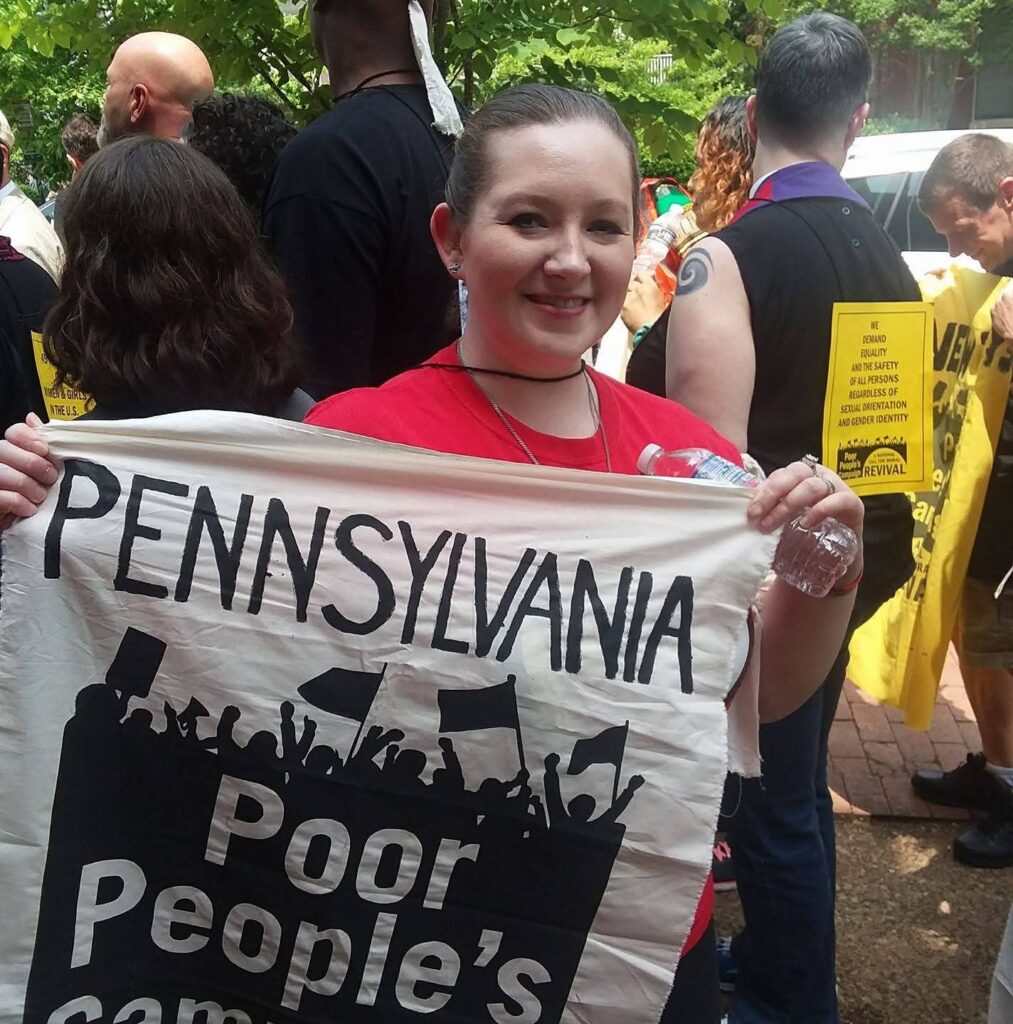
Jennina Gorman, a single mother of five, lives with a rare lung disorder. At 7, she was the oldest known living survivor of the condition. She has outlived its short life expectancy, and during 10 years of being mostly symptom-free, she worked full time. When her symptoms returned and progressively worsened, she had to stop working. Now she could lose her coverage through Medical Assistance for Workers with Disabilities, Pennsylvania’s Medicaid program for employed people with disabilities.
Gorman described the “hoops and hurdles” she has faced to keep her health care.
“Having to get constant letters signed and documented by my doctor, which is frustrating for my doctor,” she said. “Having to make the appointments to do that, then make appointments to bring those to my caseworker. There are days where I really struggle to breathe and it’s hard to move around. If I don’t get the paperwork turned in, I lose my medical coverage. I have a nebulizer and inhalers that are mitigating my symptoms. They can’t really fix it, but they help. If I lose my Medicaid, I lose those things. If I lose those things, realistically, it would probably be only about two weeks until I die.”
Gorman, who lives in Altoona, Pennsylvania, had been seeing a lung specialist there, but the doctor wasn’t familiar with her disorder and treated it as severe asthma. Now she drives three hours each way to Pittsburgh to see a specialist who better understands her condition. Sometimes she can stay with fellow organizers from Put People First! PA, a group she has worked with for 10 years.
“It’s just a lot of stress, a lot of strain,” she said. “They said that the more stress that I’m put under, the worse my prognosis becomes. They really don’t know how much longer I have to live with how rapidly my lungs are declining.”
Rural health care systems are already under enormous strain, and access to essential care is limited. Arkansas, the sixth most rural state in the country, has one of the nation’s highest maternal mortality rates. Only 22 of Arkansas’ 75 counties offer obstetric care.
“They’re like, ‘The birth rate’s going down?’ Well, there’s nowhere to have a baby. There’s no doctor to help you through that process. Shocker: When you don’t have care, people die,” Ellis said.
Some see the work requirements, and the disregard for their effect on rural health care systems, as a sign of how society values rural people, especially those with disabilities.
“We’ve decided not to value rural as much as urban,” said Rayna Sage, co-director of the Research and Training Center on Disability and Rural Communities at the Rural Institute for Inclusive Communities at the University of Montana in Missoula. “As a society, we could agree that it’s important to have rural places and to support the people that live there. Knowing that it costs more to keep a hospital running in a rural place, we could invest in that, but we have a for-profit system of health care.”
Sage said the country’s long shift to an urban-majority society has also changed how much people value rural areas as places where people can live, thrive and get the resources they need.
A report by Physicians for a National Health Program found that states could save significant money by ending their contracts with managed care organizations — money that could help offset the Medicaid cuts in H.R. 1.
“The bottom line of all of this is my life to them is just another signature on a dotted line,” Gorman said. “How much can they make before I die? I need to bring home that I am so much more than that.
“All of these people whose lives are at stake, we are so much more than just a number on a page. We deserve the right to live, to health care, to be with our families next year. The reality is that these cuts take place and a lot of us won’t be here with our kids next year. A lot of us will be gone. … I am in the fight until I can’t fight anymore.”
Josh Rinaman, a Medicaid recipient in Johnstown, Pennsylvania, who has type 1 diabetes, is also an organizer with Put People First! PA.
“I recently lost my older sister after losing her battle with cervical cancer and the issues that she had with her disability and getting the adequate care that she needed. There’s a lot of unanswered questions that we have from that,” Rinaman said. “That’s why health care is so important to me, and I’ve joined Put People First! PA and the Nonviolent Medicaid Army to demand health care as a human right, because everybody has a right to live.”
Organizations that serve rural residents and people with disabilities are doing what they can to prepare for the work requirements with limited resources.
“We’re already feeling the impact of states getting ahead of these budget cuts,” Ellis said. “Come Jan. 1, it’s going to be really troublesome. People who are already stretched thin, doing the best they can with what they have, are going to be pushed to the brink.”
More DJA Coverage
Put simply, last Tuesday’s midterm elections mean that two of the biggest thorns in the side of the disability...
By
November 10, 2026
We’ve written extensively at DJA about how responses to disasters like tsunamis and earthquakes tend to be inaccessible. That...
By
November 5, 2026
Laura White, 40, of Michigan, paid the same fee as everyone else when she applied for her professional license...
By
November 2, 2026