Every day should be a celebration of marginalized identities. But as Black History Month draws to a close, it’s important to highlight the intersections of disability and Blackness. The late Johnnie Lacey—more about her below—noted that ableism within the Black community is no less prevalent than anti-Black racism from outside of it.
Moreover, with disability policy and advocacy movements largely centering white experiences, Disabled Black folks must navigate both racist and and ableist systems.
As scholars like Wanda J. Blanchett and others have documented through research, we know that Black and Latino kids are disproportionately identified for certain disability categories and placed in more restrictive educational settings, feeding the school-to-prison pipeline.
We could go on and on, but thankfully there have been scores of Black folks fighting these systems every single day throughout history. Many are still with us; some have become ancestors.
Happy Black History Month!
Anita Cameron
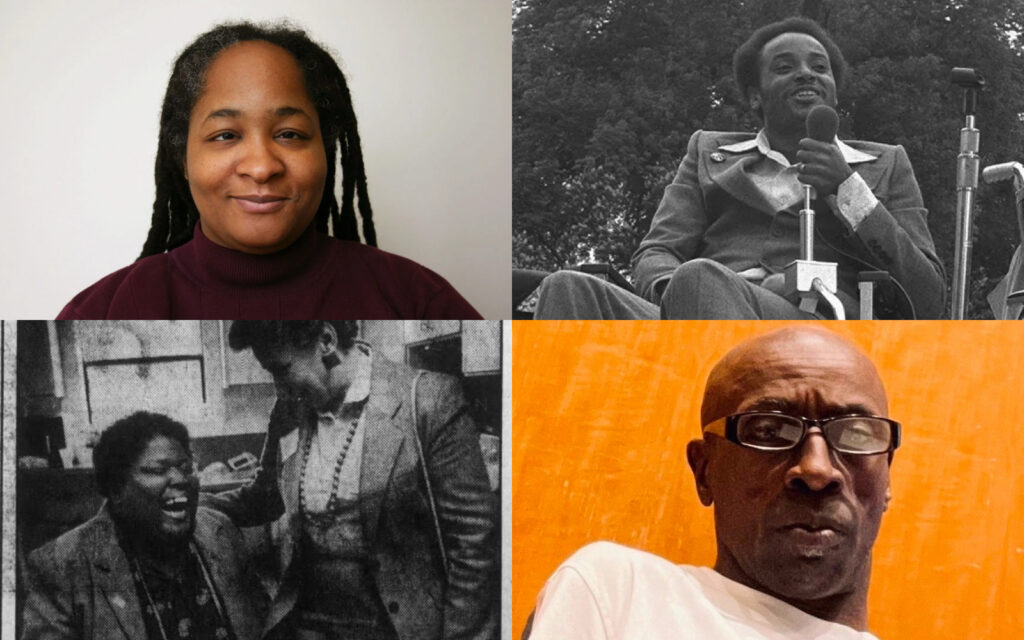
Anita Cameron is a Black disability-justice activist working to organize change for over four decades. She is a longtime leader of ADAPT, where she has been arrested more than 100 times in acts of nonviolent civil disobedience while fighting for accessible transportation and disability justice. Cameron has also worked extensively on accessible voting rights as well as emergency preparedness training, preparing and teaching hundreds of advocates nationwide.
Since 2017, she has served as Director of Minority Outreach for Not Dead Yet, where she works to combat medical discrimination and oppose the legalization of assisted suicide and euthanasia. Cameron is also a published writer, producing books and essays that look at social justice. She lives in Rochester, New York, with her wife and their cats.
— Sonali Gupta
Brad Lomax
Brad Lomax is today seen as one of the key figures bridging the Civil Rights Movement of the 1960s and the disability community at large. Born in Philadelphia, Pennsylvania, he was diagnosed with multiple sclerosis as a teenager. A wheelchair user, Lomax was a central organizer of the 1977 Section 504 sit-in, which took place in San Francisco and became a critical moment in the disability-rights movement.
Lomax also secured Black Panther support for the sit-in as a founder of the D.C. chapter of the Black Panther Party, which further fused the two movements together. Brad Lomax died in 1984 at the age of 33, having devoted his life to cross-movement solidarity before there was such a term. His legacy is one of coalition building and creating a synergy between two of the most important liberatory movements in U.S. history.
— Sean Kelly
Johnnie Lacy
In 1988, when the San Leandro, Calif., City Council said accommodating disabled citizens at voting precincts was tantamount to special treatment, Johnnie Lacy wasn’t having any of it. At the time, Lacy was executive director of the Center for Independent Living in Hayward, in the Bay Area.
“People say, ‘We’ll make it easier to vote — you won’t have to come out of your house.’ But that’s not what disabled people want: to be limited to their homes,” Lacy told the Oakland Tribune at the time.
Lacy’s activism through the independent living movement was crucial for disability rights in the years leading up to the passage of the Americans with Disabilities Act. Born in 1937 in Arkansas, Lacy spent part of her childhood there and in Louisiana before her family moved west during the Great Migration, settling in California when she was 10.
At 19, she contracted polio and began using a wheelchair. Lacy would spend her life highlighting the relationship between Blackness and disability, fighting ableism within disability communities. She attended San Francisco State University and later helped found the Berkeley Center for Independent Living. Although she graduated in 1960, she was not allowed to participate in the commencement ceremony.
Lacy, who died in 2010, consistently emphasized her complex identity as an African American and a person with a disability. She wrote: “I believe that African Americans see disability in the same way that everybody else sees it — worthless, mindless — without realizing that this is the same attitude held by others toward African Americans.”
— R.L. Nave
Keith Jones
Keith Jones’ life and career defies simple categorization. On one hand, he’s been a musician, on another a lifelong advocate, he’s an unapologetic disability activist, an entrepreneur, a community elder, an author, a father and an award winner.
What Keith isn’t is a person who settles. Growing up in 1970s St. Louis, Jones pushed back against a school system that kept telling him—in a time before landmark American disability rights legislation— that what he wanted out of life was not on the cards. In his words, he was fighting against a version of the world that didn’t want to see him succeed: “You want me to go out and… produce and put into this economy but from the time I’m born to the time I die I’m being told that I ain’t shit?”
You also cannot, and should not, separate Keith’s work from his identity as a Black man in America, as he told the American Bar Association last January, “Being a black disabled man in the United States, a descendant of people who were stolen and brought here, and the first generation of my family with civil rights, voting rights and the right to attend mainstreamed and integrated schools have shaped my activism. I have to fight for opportunities because of how someone perceives my humanity.”
After his time in St. Louis, Jones moved to Boston, fighting like hell the whole way. He co-founded Krip Hop Nation in the 1990s, a collective focused on creating musical opportunities for Disabled artists in an industry that is only just now reckoning with how Disabled people have shaped its past and its future. A film featuring Jones on the soundtrack, Rising Phoenix, won an Emmy and was submitted to the Oscars.
You can find his writing on substack: https://keithpjones.substack.com/
— John Loeppky
Image: Clockwise from top: Anita Cameron, Brad Lomax, Johnnie Lacy (left), and Keith Jones
More DJA Coverage

This week, we have New Hampshire politicians looking to technology to support the state’s disability support system; a slur...
By
April 16, 2026

A new report from the National Institutes of Health is drawing attention to developmental language disorder (DLD), a communication...
By
April 13, 2026

This week we have two (fairly dire) updates: a legal case that has dragged on for more than 15 years,...
By
April 7, 2026