Credit: Visit Duluth
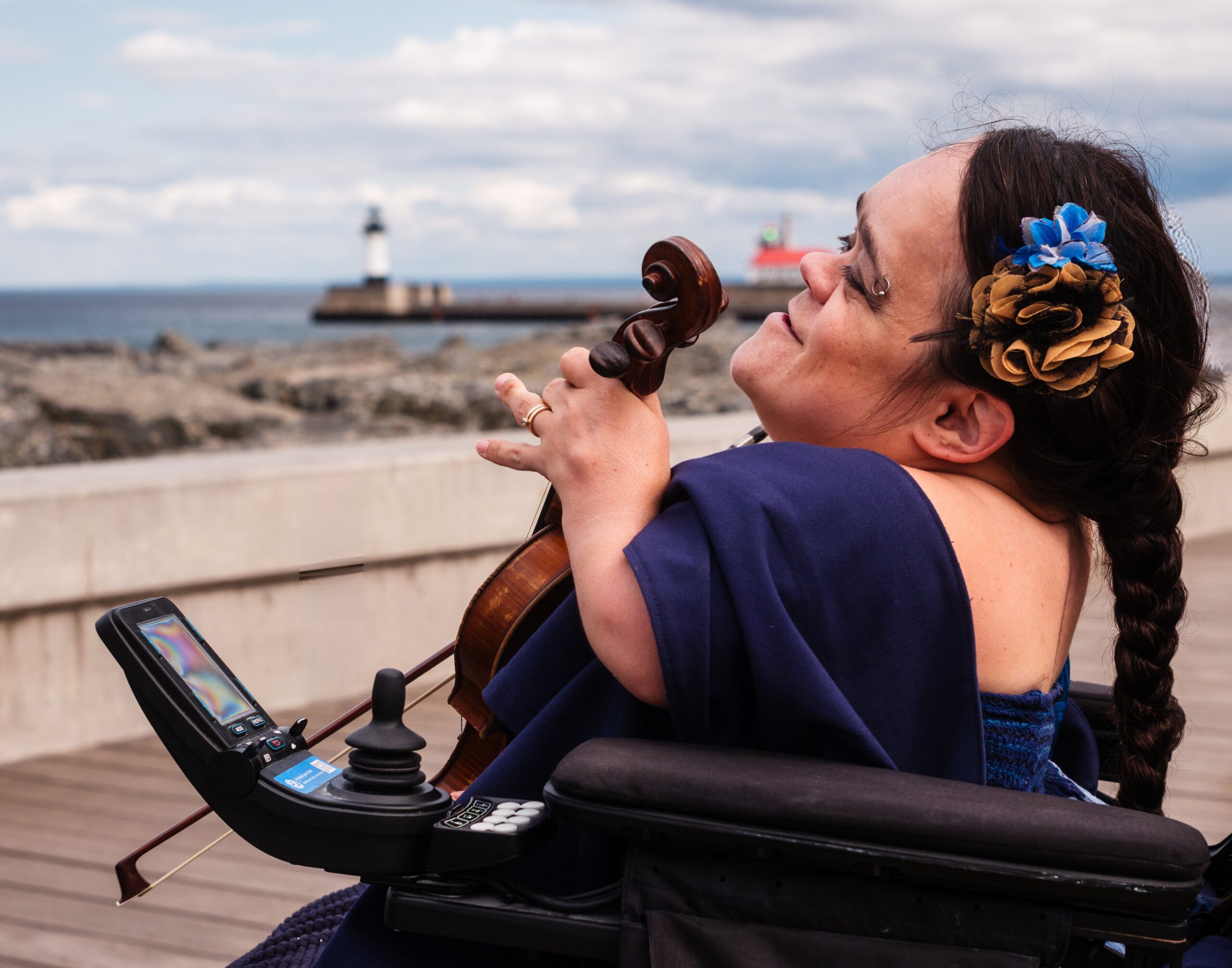
Within Disabled communities, music can be therapy; music can be solidarity; and music can be a livelihood. Still, there are barriers for many Disabled musicians, regardless of their background.
David Segal is a drummer and one of the founding members of Can-Do Musos, a nonprofit organization working to create opportunities for disabled musicians. His original dream was to become the next John McEnroe, but he chose drums over professional tennis.
“I was in junior high school, and there was this band that was playing as part of one of the assemblies that we did. I was just completely enthralled by the drums. And I had seen it a couple times, but it was this one moment where like, I can’t let this drumming that’s inside me sit for any longer. I had to do something about it,” Segal told DJA.
From there, Segal met Fred Klatz, a New York City-based musician who would become a mentor after Segal’s mother found him at a local music store. Due to Segal’s disability, the pair had to find ways to adapt, including taping the sticks to his arms. He would go off to college, where he enrolled in radio and media studies at Hunter College, following in his mother’s footsteps.
While in college, he joined the jazz band, worked at various radio stations and, after graduation, at an independent record label. All the while he sent his music from The Sin Taxes, a band that he was in, to other stations for them to promote. He would go on to train with local stars like Dom Famularo and Jim Chaplin and founded the nonprofit in 2013. Ten members from Can-Do Musos were featured in the “Yes I Can” promotional video for the Rio 2016 Paralympics. Still, he says that people often reject him from gig opportunities because he is Disabled.
“I’ve submitted a tape before, and they’re like, ‘Oh, it sounds great. I didn’t know you were disabled.’ And that’s where I take the hint that they’re not gonna hire me — it’s just the reality of the situation. So I try to always be up front about [saying] I have a disability,” Segal told DJA.
Disability History and Music
Disabled people often feel isolated in their lived experience in school, work, and downtime. Music helps alleviate that feeling of separation and can be used as a tool for self regulation or just to enjoy a moment of melodies.. This isn’t a new phenomenon; many famous musicians have been Disabled, including classical giants like Beethoven, and music therapy has many therapeutic uses for Disabled people of all ages.
Joseph Straus, a professor of music at City University of New York (CUNY) who studies the intersection between disability and classical music, says that Disabled musicians often face barriers that stem from the medical model of disability, just like their non-musician peers.
“In history, the medical model prevailed and people thought about disability exclusively as a deficit, as a problem, as a disease, as something to be ashamed of, and as something to be cured if possible. And, if not cured, then we have to put you away somewhere where we don’t have to look at you and think about you. And so that was very much the understanding of disability for [a] very, very, very long time.”
Strauss says those barriers can take many forms.
“In the classical tradition, you have to be able to write music notation, you have to be able to do certain kinds of basic musical skills and [if] you can’t do those skills…” Strauss told DJA. “Then of course, there are personal barriers too. Sometimes people feel inadequate or people have been told that they’re inadequate.“
In terms of what historical representation has looked like, Raymond Knapp, Professor of Musicology, Disability Studies and Humanities and Director of The University Of California, Los Angeles Center for Musicians Humanities , says that one way these barriers can be shifted is within representation in musicals.
“One of the things that comes in, both in my writing and in my teaching, is the need to understand these things better when depictions of disability are useful and when they simply reinforce existing stereotypes, tropes of overcoming, or miracle cures and things like that…So understanding how this works and how it might be presented differently in musicals has been an important development,” Knapp said.
Disabled Musicians Supporting Community
One of the disabled artists using their talents to uplift their community is Andre Louis, a keyboard player, producer, composer and MIDI drummer based in London. His parents introduced him to music as a three year old.
“I went to a boarding school for [the] visually impaired… My teacher saw that I wanted to create things, and so she took time out of her day after school one day and sat me down, and she’s like, ‘I’ve been through the manual. Here’s what I know, and I’m not very good with it,’ she said, ‘but hopefully you will be.'”
Now a member of Recording Artists and Music Professionals with Disabilities, or RAMPD, an organization focused on highlighting professional Disabled talent in the industry, Louis uses his skills to support others in his community. One experience with a prospective student stands out to him.
“He called me. I don’t know how he found me. I think a word-of-mouth [thing] again. And he said, ‘So this is what’s happening. When you teach me, will it be accessible? Will I be able to do it myself?’ I say, ‘Listen, I’m blind, you’re blind. If I can’t help you be comfortable in this software, then I failed at my job.’ And we had a really great relationship, so much so that one day he invited me up to his place for a day and his wife cooked me the best curry I’ve ever had in my life,” Louis said.
As a teacher who can understand and relate to his students with similar lived experience, his mission is to create independent leaders who take charge of their craft confidently
“So, one of the philosophies I have, and one of the mottos I give to my students is: don’t be the back-seat driver that you have been; be the front-seat driver I know you can be.”
Another disabled artist making waves is Precious Perez, an advisor RAMPD, founded by disabled musicians Lachi and Gaelynn Lea. Perez is a reggaeton artist who says that being mentored by artists like Ivy Queen, a Puerto Rican reggaeton rapper, has made a real difference in how she creates art and shows up for her community.
“I think that [without] being empowered by RAMPD, I feel like I would definitely not be where I am today. I’ve met some people, made some connections that I wouldn’t have. I’ve gotten featured and things I wouldn’t have gotten without RAMPD. So, I’m extremely grateful for that. But I do think that this is a movement because there’s still work to be done and disability representation, like any other minority group, needs to be in the mainstream. And also, you know, disability is the one minority group that anyone could join at any time,” Perez said.
She first showed interest in music at the age of 3. At 6, she started singing and joined a choir a couple of years later. She created her first album with the help of her high school music teacher and a Kickstarter campaign. She released her first album as a freshman at Berklee College of Music.
Makena Metz is a disabled songwriter for television and theater. In college, she changed her focus from studying drums to theater and found a way to connect the instrumentals that beat within her heart
“…I’ve always heard melodies in my mind. I’ve always been able to come up with a melodic line on the spot. So I started to write topline with my collaborators and, eventually, I got brave enough to start composing my own music,” Metz told DJA.
Metz said a few of barriers that disabled musicians face are that stages aren’t built to be accessible, support actors with autism and if the stage manager or productions can assist them in their needs.
“Pop stars keep stuff like that pretty under wraps because their producers are probably like no one in the audience wants to know you’re suffering while you’re standing on stage and singing or that you have to think about that while you’re up there playing piano. But it’s really helpful to see that as a disabled songwriter because you’re like, ‘Wow, if Lady Gaga can do it, so can I.’”
And Now For A Little Bit of Music
Music is so good at connecting your community and your life. As Perez put it, “I think representation of [our music in] the media is really powerful and I think there’s been steps in the right direction and we just got to keep going.” To that end, here is a list of songs by Disabled artists and songs that we at DJA think you should listen to.
- – Esa Mulata — El Valien-T –
- – EN LA SANGRE 🩸- LANGUI ❌ GITANO ANTON = LA EXCEPCION Feat Irie Angel (Video Oficial)Prod LaDakostyle
- – “Watch the World Unfold” by Gaelynn Lea
- – No Me Hizo Falta Verte — Precious Perez
- – Diseducation — Lachi
- – Sneaky link — Mini Producer
- Reggae Beat (Remix)– Clint Warren
- – Barrio — Natalis
- – 12 — Dom Kelly ft (feat. Emily Saliers)
- The Sound of Silence (Cover Version) — Orod Kaveh
Disabled people have created our own territory when it comes to music yet, sometimes, we’re left with the shadows of their melodies and voices.
But not if those who spoke to DJA for this story can help it.
More DJA Coverage
I met Alice five years ago, at the start of the hardest point in my life. My brother was...
By
March 25, 2026
We’ve been asked repeatedly at DJA why we capitalize the word Disabled in our reporting. So, for this piece,...
By
March 23, 2026
In this week’s edition we have a win for the Welsh Deaf community, future health funding cuts in Idaho,...
By
March 17, 2026