Laura White, 40, of Michigan, paid the same fee as everyone else when she applied for her professional license as a mental health therapist. But completing the application came with other costs her non-Disabled colleagues didn’t have to pay.
“I didn’t pay more in terms of financials when I applied for my license. But I paid more in time, in effort, in energy and emotional investment because the website wasn’t accessible with Chrome or Safari,” said White, who has been blind since birth. “So, I had to then wait and I had to get help and I had to find somebody who could help me do what I should have been able to do on my own. So, the payment isn’t always financial.”
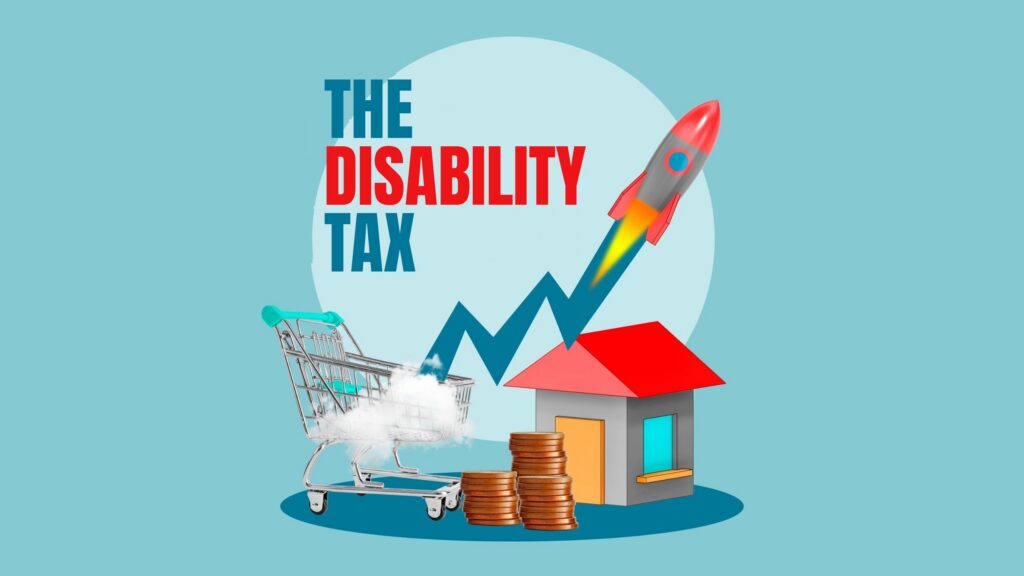
She calls that accumulation of extra costs a “disability tax.”
Affordability has remained a major national concern through the past two election cycles. Americans continue to wrestle with the cost of housing, food, health care and other necessities, and those worries are carrying into the 2026 midterms. About 84% of registered voters surveyed by the Pew Research Center this fall said the economy was very important to their vote, making it the top issue among both Republican- and Democratic-leaning voters. Earlier polling also singled out the cost of living and affordability as especially prominent concerns, suggesting household expenses will weigh heavily on voters this election.
The cost of living has continued to rise. Consumer prices increased 3.7% over the 12 months ending in September, affecting how Americans live, work and eat. But for Disabled people, higher prices collide with expenses and needs that aren’t optional. Many are stretching tight budgets, relying on friends and neighbors and finding new ways to meet their most basic needs.
The disability tax isn’t a government levy or a charge that appears on a receipt. It is paid in time, effort, privacy and emotional energy. Sometimes several of those costs converge.
Digital accessibility and visible expenses
Digital barriers remain widespread. WebAIM’s 2026 analysis of the homepages of the 1 million most popular websites found detectable Web Content Accessibility Guidelines failures on 95.9% of them. Because automated testing can identify only certain accessibility problems, the organization cautions that the figure doesn’t capture every barrier a Disabled user might encounter.
For White, some disability-related costs do appear directly in her budget.
“I buy my cane. Nobody buys my cane,” she said. “I buy like four of them at a time every single year. And I buy extra because if you break it, you’ve got to have a replacement. It’s my eyes.”
From the outside, a piece of software, a mobility device or another adaptive tool can seem like just another purchase. For the person relying on it, that tool makes it possible to communicate, work, navigate information or manage daily life. But not every disability cost can be tallied.
Mason Douglas, 38, a peer specialist living in rural upstate New York, struggled to put a dollar amount on what disability costs him.
“What are the increased costs with the way my disability affects me in my life? It costs more time,” he said. “I think that is the most tangible way of putting it because I can’t really put dollars and cents on it.”
Transportation is one example. He described meeting a friend downtown for an hourlong breakfast, then having to wait three hours for the next bus home.
“That takes away from my sense of independence because that means I don’t get to do other things with my time based upon the restriction of where I am in my area,” he said.
Waiting for a ride, waiting for assistance or arranging life around another person’s availability may not create a bill. That doesn’t mean those things come without cost.
Douglas calls them the “hidden costs of being disabled.”
There can be a privacy cost, too. White said inaccessible medical forms routinely require her to depend on another person. When she began seeing a therapist, the paperwork was inaccessible, so her therapist offered to help complete it during their first session.
The problem follows her to other medical appointments.
“Every doctor’s appointment I go to, I can’t do my own paperwork,” she said.
When another person has to read or complete information that a patient should be able to handle privately, another part of the price becomes apparent.
“Then you suddenly don’t have privacy,” White said.
The one-size-fits-all myth
Those examples point to a problem I have described for years as trying to force a square peg into a round hole. Programs, policies and systems are often structured around a single way of completing a task, getting somewhere, communicating or receiving a service. Disabled people, however, do not all have the same set of needs. When the system and the individual don’t fit, the burden of finding a workaround falls on the individual, whether or not they choose to carry it.
I mentioned the square-peg comparison while interviewing Laura Calascione-Nguyen, 46, of New Jersey. She immediately added to it: “And then yelling at it, ‘Why won’t you fit?’”
It is a simple analogy, but the interviews conducted for this series repeatedly reflected it. A person may be capable of doing something while the system around them makes that competence harder to exercise. The workaround can require money or assistance from another person. It can also consume hours and energy that could have been spent somewhere else.
White described the emotional effect of encountering that disconnect while trying to purchase professional liability insurance. She could navigate the process but couldn’t independently check the online box accepting the terms and conditions.
“When you go to do something and you know that you’re capable but the systems are not in place to make your capability and your functionality possible, suddenly as a capable adult, you feel like you’re five,” she said. “You’re like, well, wait, I didn’t do anything wrong. But you can’t fix it either.”
That’s part of what makes the disability tax difficult to calculate. Some costs can be entered into a spreadsheet. A cane has a price. Software has a subscription fee. Other costs disappear into a calendar, a missed opportunity, the need to ask someone for assistance or the loss of privacy when a system cannot be used independently.
And the people paying those costs are not a small, permanently separate group.
“Disability is a club that if you live long enough, you will be invited to,” White said, “whether chronically or acute, whether permanent or temporary, at any age, visible or invisible.”
The price of joining that club will not look the same for everyone. But it is worth asking how much of that fee comes from disability itself and how much from a world that still expects everyone to fit the same mold.
Read the entire Cost of Living Crunch series:
- The Disability Cost-of-Living Crunch: When you’ve cut everything and still can’t live
- The Price of Independence: Why freedom of choice comes at great risk
- The Accessibility Premium: When the cheaper option isn’t really an option
- The Disability Tax: Why extra costs of being Disabled aren’t just dollars and cents
More DJA Coverage
Tiana, 33, of Windsor, Colorado, who asked that her last name not be published, expected her ride home from...
By
October 30, 2026
For Ricole Wicks, 38, an entrepreneur from Greensboro, North Carolina, independence means preserving enough energy to get through the...
By
October 29, 2026

When a gunman walked into a school in Bend, Oregon, last month, he didn’t shoot at just any classroom....
By
October 29, 2026